
When you blank in an oral exam, pause and take a slow breath, repeat or rephrase the question, and start from anything you do know about it: a definition, an example or a related idea. Thinking out loud is allowed and often leads you back to the answer. If nothing comes, say so briefly and ask to come back to it. Blanking is common, and how you handle it matters more than the blank itself.
Why your mind goes blank
Going blank is not the same as not knowing. Under pressure, your attention is pulled towards the pressure itself, and an answer you knew an hour ago becomes hard to reach. Oral exams make this more likely than written ones: there is no time to scan the paper, and someone is watching you think.
The good news is that recall under pressure is a skill. The more often you have retrieved an answer out loud, the easier it is to reach when it counts.
What to do when you blank, step by step
- Pause. Take one slow breath. A few seconds of silence feels long to you and normal to the examiner.
- Repeat the question, out loud or in your head. Often the blank is about the question, not the answer.
- Ask for clarification if you need it. 'Do you mean in adults or in children?' buys time and narrows the question.
- Start from what you know. Define the key term, name the category it belongs to, or give an example.
- Think out loud. Examiners can follow your reasoning, and many will give you credit or a nudge for it.
- Use a structure. Causes, mechanism, consequences; or definition, example, exception. A frame gives your memory something to fill.
- If nothing comes, say so and move on. Asking to come back to it is better than a long silence.
What to say when your mind goes blank
| Situation | What you can say |
|---|---|
| You need a moment | Let me think about that for a second. |
| The question is unclear | Could you rephrase that? Do you mean the first case or the second? |
| You know part of it | I am not sure of the full answer, but I know that… |
| You know a related idea | I would approach it from… |
| Nothing comes | I cannot recall that right now. Could we come back to it? |
| You realise you were wrong | Actually, let me correct that. |
How to make blanking less likely
Most blanks come from preparation that never involved speaking. Reading and rereading build recognition; an oral exam needs recall, out loud, in full sentences.
- Practise answering out loud, not just in your head. Explaining is a different skill from knowing.
- Prepare an opener for each topic: one sentence that defines it and one that says why it matters. It is your way in when you blank.
- Practise with follow-up questions, because the second question is where many students get stuck.
- Review with active recall in short, spaced sessions, so the answers are well worn by exam day.
- Simulate the pressure: a timer, someone listening, no notes.
If exam stress regularly gets in your way, your university's student support service is a good place to talk it through.
Practise blanking, and recovering, with Professor Ka
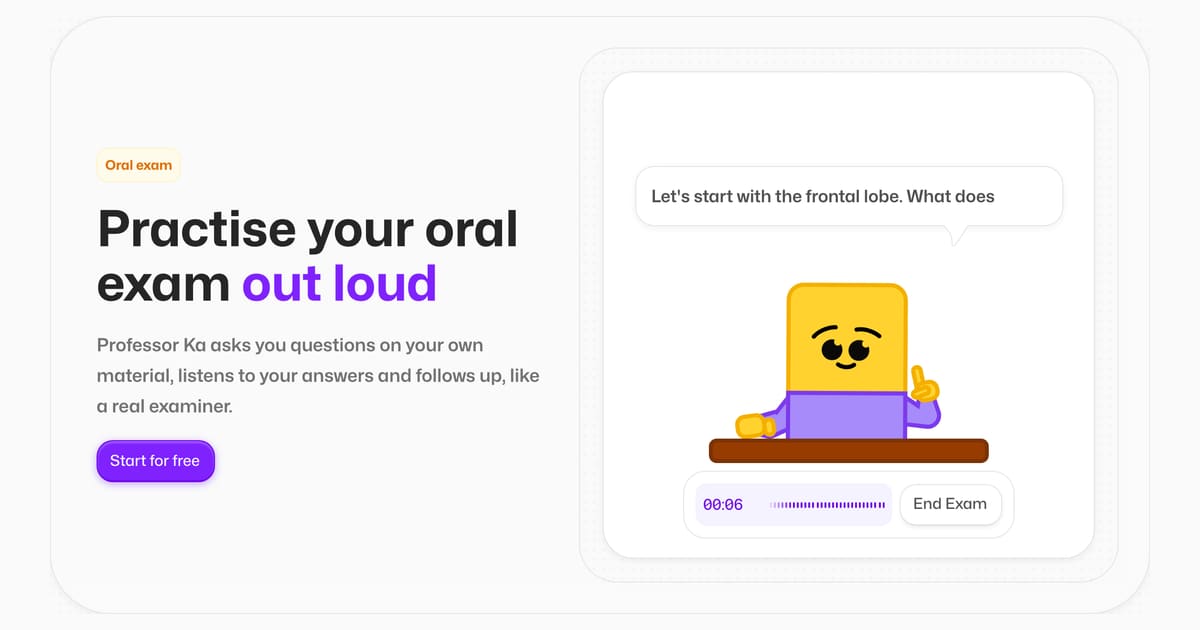
The best way to get used to recovering from a blank is to have a few in practice. Flashka's oral exam is a spoken conversation with Professor Ka on your own material: he asks a question, listens, follows up on the gaps, and moves to another topic once you have shown what you know.
You can pause and think out loud, as you would in the real exam. Saying 'wait' or 'hold on' is taken as a pause, not as a request to end the exam. Ka never gives an answer away during the exam, so you have to work your way to it, and the report at the end shows, answer by answer, what you got right and what you missed.
For a longer warm-up, Open Recall asks one broad question and gives you up to 30 minutes to say everything you know. For a full preparation plan, see how to practise for an oral exam or, for a thesis, how to prepare for a viva.
The short version
- Pause, breathe, and repeat the question.
- Start from what you know, and think out loud.
- If nothing comes, say so and ask to return to it.
- Prevent blanks by practising answers out loud, with follow-up questions.


