
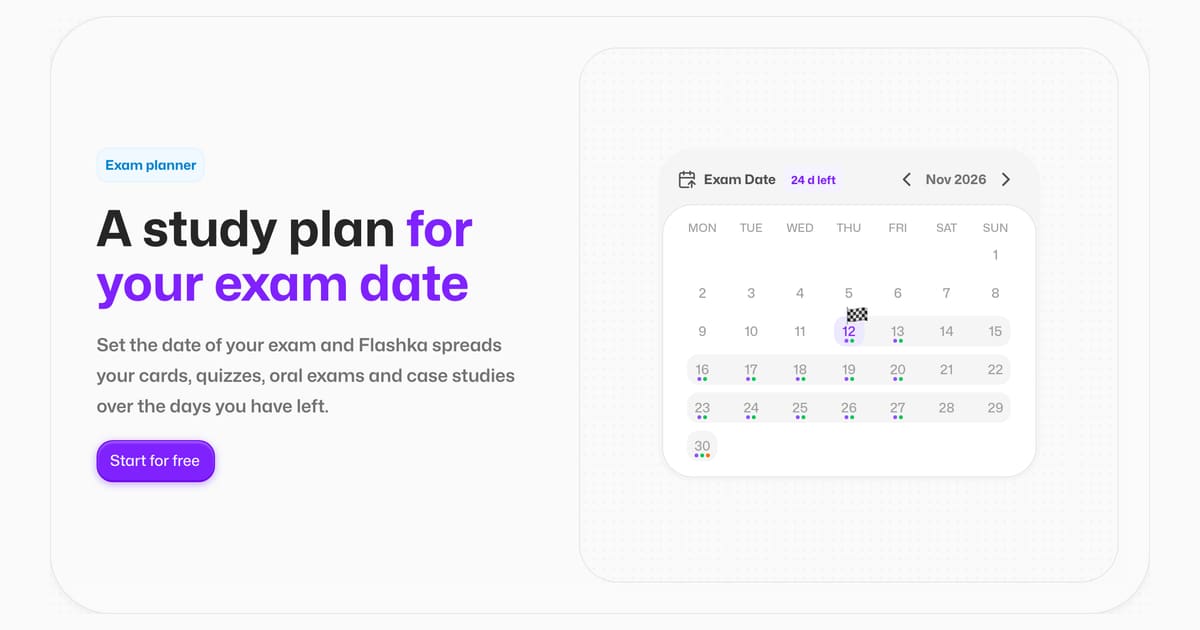
To revise for GCSEs, list every subject and topic you will be examined on, rate how well you know each one, and spread short sessions of self-testing over the months before the exams, moving on to past papers in the final weeks. Revision that works means answering questions from memory, not rereading or highlighting. Here is how to revise for GCSEs with a plan you can actually keep.
When should you start revising for GCSEs?
GCSEs are unusual because you sit many subjects in the same few weeks. No amount of cramming in the last fortnight covers all of them, so the earlier you start, the less each week has to hold.
A sensible shape is light, regular revision from the start of the exam year, a proper timetable from a few months out, and past papers in the last six to eight weeks. If you are starting later than that, do not panic: start today, cut the plan to the topics that carry the most marks, and keep reading.
Step 1: find out what you need to know
Before you revise anything, make a list. For each subject, get the topic list from your teacher or from the specification your exam board publishes, and write every topic down.
Then rate each topic honestly. Many students use a traffic light:
- Red: I could not answer a question on this today.
- Amber: I know some of it, but not well enough to write it down.
- Green: I could answer an exam question on it now.
Do not rate topics by how familiar the notes look. Rate them by trying a question or writing down what you remember for two minutes. Familiar is not the same as known.
How to revise for GCSEs: build the plan
- Write down every exam date as soon as you have the timetable.
- Count the weeks you have and the topics in each subject. That tells you roughly how many topics a week to cover.
- Start with the reds in the subjects that come first, but touch every subject every week, so none goes cold.
- Mix subjects within a day. Two or three subjects a day, one topic each, beats a whole day on one subject. Switching makes recall harder in a useful way.
- Leave one catch-up slot a week. Something always slips, and a plan with no slack collapses the first time it does.
| Phase | When | What to do |
|---|---|---|
| Learn | Months before | Go through topics one by one, make flashcards, test yourself weekly |
| Practise | Last six to eight weeks | Past paper questions by topic, marked with the mark scheme |
| Rehearse | Last two weeks | Full timed papers, your mistake list, light review of every card |
What a GCSE revision session should look like
Keep sessions short and the same shape every time, so you never waste the first half hour deciding what to do.
- Start with retrieval. Ten minutes of flashcards or questions on topics you covered in earlier weeks.
- Learn one topic. Read your notes or the textbook once, carefully, asking what the exam could ask about it.
- Turn it into questions. Write flashcards or practice questions while it is fresh.
- Test yourself straight away. Close everything and write down what you remember. The blurting method is made for this.
- Write down what you got wrong, so the next session starts there.
Revision methods that work, and ones that only feel like work
What works: flashcards with spaced repetition, exam-style questions, blurting, and explaining a topic out loud. Each one makes you pull the answer out of memory, which is what the exam asks you to do.
What feels productive but costs you hours: rereading, highlighting, and copying notes out neatly in colour. If you like making notes, make them short and make them into questions. Here is how to make revision notes that actually help.
Past papers in the final weeks
Past papers show you the questions in the form you will meet them, and the mark scheme shows you what earns the marks. Start with single questions by topic, then move to full papers against the clock.
Your mistakes teach you more than your right answers. Write a flashcard for each one so it comes back. Our guide on how to revise from past papers goes through it step by step.
Keep the plan going
A revision plan only works if you can keep it up for months. Fix a start and a stop time each day, keep one evening off a week, and protect your sleep: tired revision is slow revision. If a day goes wrong, do not try to double up tomorrow. Move the topic to your catch-up slot and carry on.
The short version
- List every topic for every subject and rate it red, amber or green by testing yourself.
- Plan a mix of subjects each week, with a catch-up slot, starting from the reds.
- Every session: retrieve old topics, learn one new one, turn it into questions.
- Past papers in the final weeks, with a flashcard for every mistake.


