
To make a study schedule for finals, list every exam with its date, estimate how much material each one covers, then work backwards from the dates so each subject gets short, regular sessions spread over the weeks you have, with the biggest and earliest exams starting first. Put self-testing in every session, leave buffer days, and keep the last days before each exam for review rather than new material. Here is how to build one, with an example.
What a good finals study schedule does
A study schedule is not a list of hours to sit at a desk. It is a decision, made in advance, about what you will study on each day, so you do not have to decide when you are tired.
A good finals schedule does three things:
- It spreads each subject out. Short sessions over several weeks do more than the same hours crammed into the last few days, because of the spacing effect: memories revisited after a gap last longer.
- It mixes subjects. Two or three subjects a day keep each one coming back at intervals, and stop you from spending a whole week on the subject you like.
- It is built on questions. Each session ends with you answering questions without your notes, not with you having read a chapter.
How to make a study schedule for finals in 6 steps
- List your exams. Subject, date, time and format. Put them on one calendar so you can see the clashes.
- Size each subject. Count lectures, chapters or pages, and mark how confident you feel about each topic. A big subject you are weak in needs more days than a small one you know well.
- Count your real study days. Take out days you work, travel or have class. A schedule that assumes seven full days a week breaks in the first week.
- Work backwards from each exam. Give each subject a start date. Earlier and bigger exams start first, and every subject should be running several weeks before its exam.
- Fill each day with two or three subjects. One block of new material, one block of review, one block of practice questions.
- Leave buffers. One light day a week, and the last day or two before each exam for review only.
If your first exam is less than a week away, use the one-week exam plan for it and schedule the rest around it.
An example finals study schedule
Say you have four weeks and three exams: Biology at the end of week 3, History in the middle of week 4, and Statistics at the end of week 4. Here is how the weeks might look.
| Week | Biology (end of week 3) | History (mid week 4) | Statistics (end of week 4) |
|---|---|---|---|
| 1 | New material daily, review cards | New material every other day | Problem sets twice |
| 2 | New material, first full quiz | New material, review cards | New material every other day |
| 3 | Mock exam, fix mistakes, then review only | New material daily, first quiz | New material, practice problems |
| 4 | Done | Mock exam, then review only | Mock exam, then review only |
No subject waits until the week before its exam to start, and each one gets a mock exam a few days out, with time left to fix what it reveals.
What to do in each study session
A schedule only works if the sessions do. Aim for blocks of 30 to 60 minutes per subject with short breaks between, each shaped like this:
- Warm up with review. The flashcards that are due, or yesterday's mistakes. Spaced repetition decides which cards come back when, so you do not have to.
- Learn something new. One lecture or chapter, read with the question: what would the exam ask?
- Test yourself. Practice questions, a quiz, or a blank page where you write what you remember.
- Write down the gaps. Turn every mistake into a flashcard so it comes back.
How to keep the schedule when your week changes
Every schedule meets a bad day. The fix is to plan for it, not to start over.
- Missed a day? Move it into your buffer day, not on top of tomorrow.
- A topic is taking longer? Trim a topic that is less likely to be examined, never your review sessions.
- Ahead of schedule? Use the time for an extra mock exam, not more reading.
- Started late? Shorten the timeline rather than skipping review. Here is when to start studying for an exam for each kind of exam.
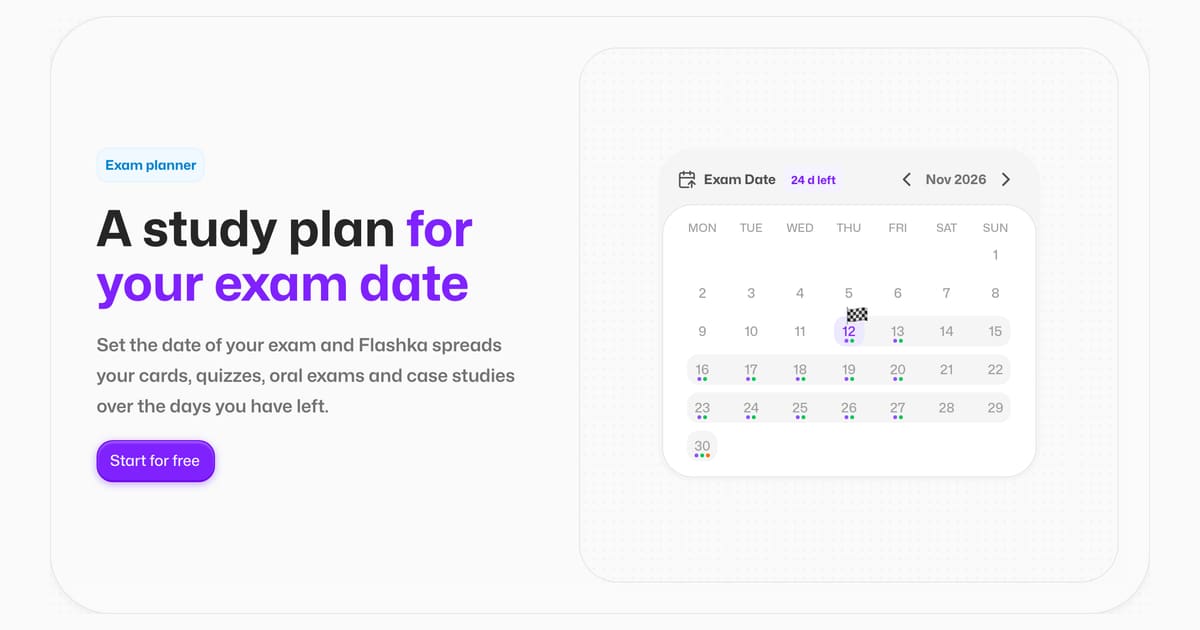
In Flashka you can raise or lower any day's targets when your week changes, and the plan shows what remains.
The short version
- List every exam, size each subject and count your real study days.
- Work backwards so each subject runs for several weeks, earliest and biggest first.
- Study two or three subjects a day, and end every session by testing yourself.
- Keep buffer days, and the last days before each exam for review only.


