
The way to prepare for an oral exam is to practise it the way it will happen: out loud, without notes, with someone asking follow-up questions. Reading your notes again builds recognition, but an oral exam tests whether you can produce an explanation from nothing, in order, while someone watches. This guide shows how to close that gap, from structuring your answers to rehearsing with an AI examiner.
Why oral exams feel harder than written ones
In a written exam you can pause, cross out and restructure. In an oral exam every sentence is final, gaps are obvious, and the examiner's next question depends on your last answer.
Most freezing comes from one thing: you have only ever recognised the material, never said it. Recognising a topic on the page is very different from explaining it from scratch, and the only fix is to practise the explaining. It is active recall in its most demanding form.
How to prepare for an oral exam in 6 steps
1. List every topic the exam can cover
Use the syllabus, past questions and your lecturer's hints. Put each topic on its own line or card. This list is your exam, so make it complete. Then spread the topics over the days you have left, so each one gets said out loud more than once; Flashka's exam planner can schedule oral exams for you.
2. Explain each topic out loud, without notes
Pick a topic, start a two-minute timer, and explain it as if the examiner were in the room. Where you stall or go vague is exactly what to study next. Check your notes, fix the gap, and try the same topic again tomorrow.
3. Give every answer the same shape
A good oral answer has a skeleton you can rely on under pressure:
- A one-sentence answer or definition.
- The mechanism or the key points, in order.
- An example from the course, the lab or the clinic.
- A link to a related topic, which invites the next question onto ground you know.
Rehearse that shape until it is automatic. The less you have to think about structure, the less room nerves have to work.
4. Prepare for follow-up questions
Examiners probe. After every answer, ask yourself "why?", "what if?" and "how do you know?", and answer those too. A follow-up is rarely a trap. It is usually the examiner giving you a chance to show more.
5. Record yourself and listen back
Uncomfortable and very useful: you hear the filler words, the vague bits and where you rushed. Fix one thing per session.
6. Practise with someone who asks back
A partner who interrupts and follows up is the closest thing to the real exam. When nobody is free, an AI examiner can play the part.
Practising with an AI examiner
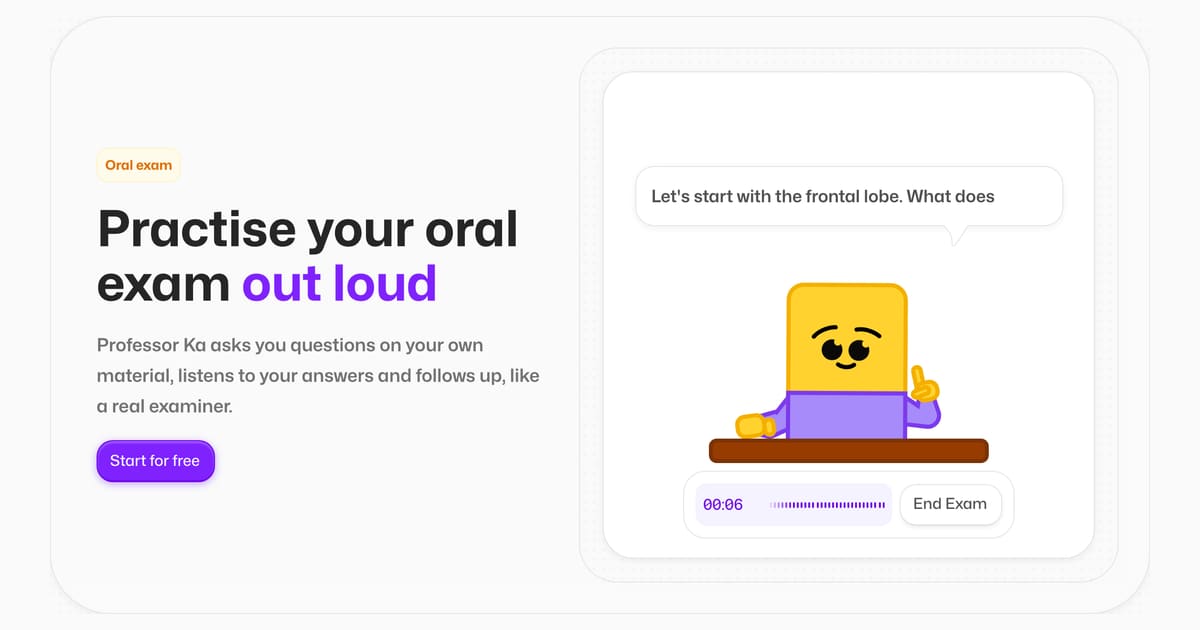
Flashka's oral exam is a live, spoken conversation with Professor Ka. You choose the material (your notes, your flashcards or a document, or just some of its pages or chapters), the difficulty and the language, and he asks the questions out loud. You just talk: there is nothing to record or submit, and you can pause and think aloud.
Like a real examiner, he follows up on the gaps in an answer and moves to a new topic once you have shown what you know. He never gives an answer away during the exam. An exam lasts four to six answers and at most twelve minutes.
At the end you get a report: each answer checked against your material and counted as right, half right or wrong, with what you got right and what you missed.
| Way to practise | Asks follow-ups | Checks you against your notes |
|---|---|---|
| Rereading your notes | No | No |
| Explaining alone, out loud | No | Only if you check afterwards |
| A study partner | Yes | If they know the material |
| Professor Ka in Flashka | Yes | Yes, in the report |
Open Recall: say everything you know
For "tell me everything about…" exams, Open Recall gives you one broad question and up to thirty minutes to answer it in your own words, with Ka listening and only nudging you to go on. Everything you said is then graded against his question.
On the day
- Start with a one-line answer, then expand. It gives the examiner something solid and gives you a moment to organise.
- Say when you are unsure and reason out loud. Examiners mark thinking, not just answers.
- Ask for the question again if you need to. It is normal, and it buys you a few seconds.
- Slow down. A pause feels long to you and normal to the examiner.
The short version
Oral exams reward practice in their own format. List the topics, explain them out loud, give every answer a shape, get used to follow-up questions, and rehearse with someone who asks back. If that someone is Professor Ka, you can do it tonight, on your own material.


