
To prepare for a viva or thesis defence, reread your thesis with fresh eyes, write a one-page summary of each chapter, list the questions examiners are likely to ask, and practise answering them out loud, ideally in a mock viva. Start three to four weeks before. The goal is not to memorise answers but to explain and defend your choices calmly, in your own words.
What is a viva or thesis defence?
A viva (short for viva voce, Latin for 'with the living voice') is an oral examination in which examiners question you about your thesis. In the US and many other countries the same event is called a thesis or dissertation defence. Formats vary: some are private conversations with two or three examiners, others start with a public presentation.
Whatever the format, the examiners want to know three things: that you did the work, that you understand it, and that you can place it in your field.
What examiners are likely to ask
| Type of question | Example | How to prepare |
|---|---|---|
| Overview | Can you summarise your thesis in a few minutes? | Practise a two-minute and a ten-minute version |
| Motivation | Why did you choose this topic? | Know the gap your work fills |
| Methods | Why this method and not another? | List the alternatives you rejected, and why |
| Results | What is your most important finding? | Pick one or two and say why they matter |
| Limitations | What are the weaknesses of your study? | Name them first, with what you would change |
| Literature | How does this relate to the key work in your field? | Reread the main papers you cite |
| Future | What would you do next? | Have two or three concrete next steps |
How to prepare for a viva, week by week
Three to four weeks before
Reread the whole thesis as if someone else wrote it. Mark typos, unclear passages and anything you would now do differently, and list corrections on a separate sheet so you can mention them. Then write a one-page summary of each chapter: its question, method, main finding and limitation.
Two weeks before
Draft answers to the questions above as bullet points, not scripts. Reread the most important papers you cite and check for anything major published since you submitted. If those papers are in a Flashka deck, Professor Ka can summarise one and names the page behind each point.
The last week
Practise out loud, every day. Explaining an idea in speech is harder than recognising it on the page, and the only way to get better at it is to do it. Arrange a mock viva with your supervisor or colleagues, and ask them to push on the weak spots.
The day before
Check the time, place and format. Pack your annotated thesis, your notes and some water. Then stop preparing for the evening.
Practise answering out loud with Professor Ka
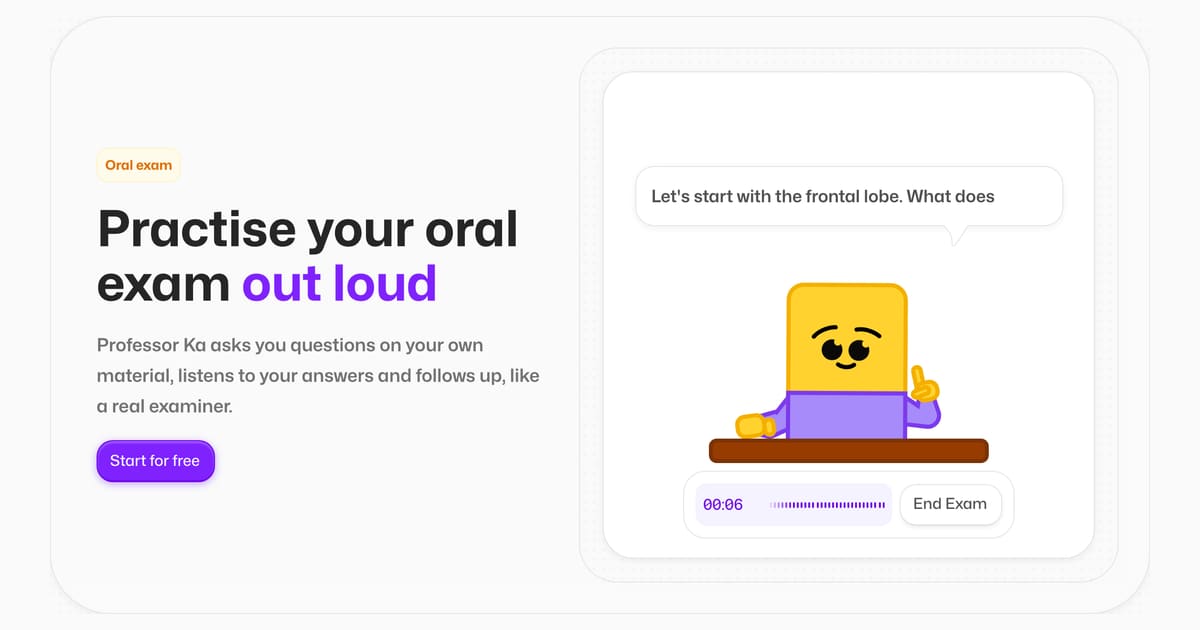
A mock viva with your supervisor is the best rehearsal, but you will probably get only one or two. For daily practice in between, Flashka's oral exam gives you an examiner whenever you want one.
Choose your thesis chapters, your notes or your flashcards as the material, set the difficulty and the language, and Professor Ka asks you questions out loud. He listens, follows up on the gaps in your answers and moves between topics, as an examiner would. He never tells you the answer during the exam; at the end you get a report that grades each answer against your material, with what you got right and what you missed.
For the summarise-your-thesis question, use Open Recall: one broad question and up to 30 minutes to say everything you know, while Ka listens.
Documents can be up to 200 pages, so a longer thesis goes in as separate chapters. Professor Ka works from your material, which makes him good at testing whether you can explain your own work; he does not replace a human examiner's view of your field. For more on spoken practice, read how to practise for an oral exam, and if nerves are the worry, see what to do when you blank in an oral exam.
On the day
- Take a moment before answering. A short pause reads as thought, not ignorance.
- Ask for clarification if a question is unclear. Examiners would rather rephrase than hear an answer to the wrong question.
- Admit limits honestly. 'That is a fair point, and here is how I would address it' is a strong answer.
- Use your thesis. Most vivas let you refer to your copy; check beforehand.
The short version
- Start three to four weeks out: reread, summarise each chapter, list likely questions.
- Practise answers out loud, not just in your head.
- Get at least one mock viva with someone who will push back.
- Use an AI oral exam for daily spoken practice on your own chapters.


