
To study for university exams, start from the module's learning outcomes and past papers to find out what is examined, review each week's lectures with active recall during the term instead of saving it for the end, and spend the last weeks practising the exam's own format under time pressure. University exams cover more material and give you less guidance than school did, so the work has to be spread out and you have to plan it yourself.
How university exams differ from school exams
Many students arrive at university with study habits that worked at school and stop working in the first exam season. The difference is not that the work is harder; it is that there is more of it and fewer people telling you what to do.
| School | University | |
|---|---|---|
| Amount of material | A textbook per subject | Lectures, slides, readings and seminars per module |
| Guidance | Regular homework and tests | Often one or two assessments per module |
| What is tested | Mostly knowing the content | Applying, analysing and arguing with it |
| Revision time | Built into lessons | Entirely up to you |
| Several exams | Spread over weeks | Often several in a fortnight |
Find out what will be examined
Before you study anything, collect three things for each module:
- The learning outcomes in the module handbook. Exam questions are written to test them.
- Past papers, if your department publishes them. Look at the format, the types of question and the topics that come back.
- What the lecturer said about the exam, especially in the last lectures of the term.
Then list the topics and rate each one: how heavily it is examined, and how well you know it. That list is the backbone of everything that follows.
How to study for university exams, step by step
- Review every week. After each lecture, write questions on the main ideas and answer them a day later. Fifteen minutes a week per module is worth more than a day in May.
- Make one set of material per module. Notes, flashcards and readings together, so revision does not start with a search.
- Plan backwards from the exam date. Count the days you have, mark the exams that fall close together, and give the heaviest modules the most days.
- Test yourself, do not reread. Flashcards, practice questions and writing out what you remember all beat rereading, because they make you recall instead of recognise.
- Practise the format. Essays, problem questions, calculations or multiple choice each need their own practice. Do past papers, timed, from about a month before.
- Mix modules in the last weeks. Alternating topics feels harder, but it is closer to the exam, where questions do not arrive in chapter order. This is called interleaving.
How early should you start?
Earlier than feels necessary. Revision for a module that you reviewed every week is mostly practice; revision for a module you have not looked at since the lecture is learning it for the first time. For a realistic timeline, see when to start studying for an exam, and if you are already behind, how to catch up on lectures.
Plan each module separately
With four or five exams in two weeks, one big revision timetable quickly becomes a wish list. It is easier to give each module its own plan, then look at the week as a whole and move days where two plans collide.
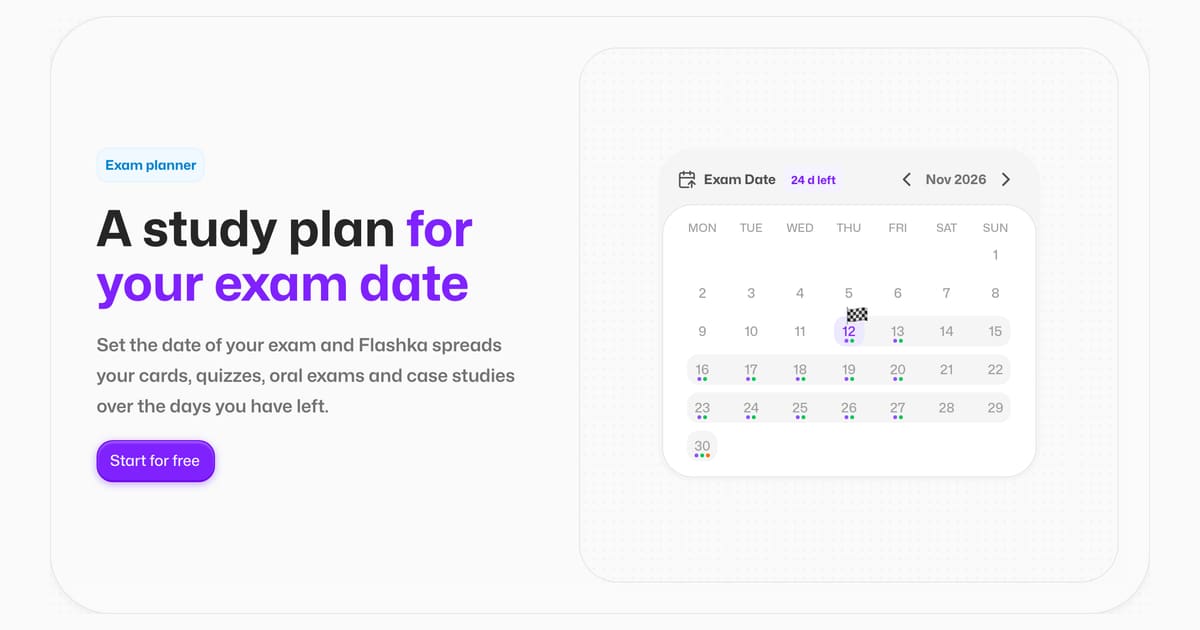
Each deck keeps its own plan and exam date, and a plan sends a daily reminder to study. When your week changes, raise or lower any day's targets and the plan shows what remains. For a worked example with several subjects, read how to make a study schedule for finals.
The last week and the exam itself
Stop learning new topics a few days before each exam. Use the time for one more past paper, your list of mistakes and a light pass over your flashcards. Sleep matters more than one extra chapter.
In the exam, read every question before you start, plan your time by the marks on offer, and answer the question that was asked rather than the one you hoped for.
The short version
- Start from the learning outcomes and past papers.
- Review each week's lectures with active recall during the term.
- Plan backwards from each exam date, one module at a time.
- Spend the last month practising the exam's format, timed.


