
To study biochemistry, learn the purpose of each pathway before its steps, draw pathways from memory until you can do it without your notes, use flashcards for the details that have to be exact, and connect the pathways to each other so you understand metabolism as one system. Most of the panic in biochemistry comes from trying to memorise every intermediate before knowing why the pathway exists.
Why biochemistry feels overwhelming
A biochemistry course arrives as a long list: structures, enzymes, cofactors, intermediates, regulation. Each pathway on its own is manageable. The trouble is that there are many of them, they share molecules, and the exam asks how they affect each other.
Students who start by memorising the steps in order usually forget them within days, because the steps have nothing to hang on. Students who start with the story of a pathway, what it is for and when the body runs it, find the details much easier to keep.
What to know about every pathway
Before you learn a single intermediate, answer these questions for each pathway. They are also what most exam questions ask.
| Question | What it gives you |
|---|---|
| What is it for? | The reason the pathway exists, in one sentence |
| Where does it happen? | The tissue and the part of the cell |
| When is it switched on? | The state of the body, such as after a meal or during fasting |
| What goes in and what comes out? | The start, the end and the net products |
| Which steps are controlled? | The key regulated enzymes and what activates or inhibits them |
| How does it link to other pathways? | The molecules it shares with the rest of metabolism |
| Why does it matter clinically? | The examples your course uses, if any |
How to study biochemistry, step by step
- Start with the big picture. Before a lecture on a pathway, place it on an overview of metabolism, so you know what comes before and after it.
- Learn the story, then the steps. Answer the seven questions above, then learn the steps, starting with the regulated ones.
- Draw it from memory. Close your notes and draw the pathway on a blank page. Check it, fix the gaps in another colour, and draw it again the next day. This is active recall for diagrams.
- Use flashcards for exact details. Enzyme names, regulators, cofactors and net yields have to be right. Cloze cards work well for sequences; see cloze deletion flashcards.
- Connect pathways. Once you know several, ask how they change together after a meal and during fasting. Draw the connections.
- Practise with questions. Exams often describe a situation, such as a missing enzyme or a change in diet, and ask what follows. Answer those questions out loud or in writing.
Use a map to see the connections
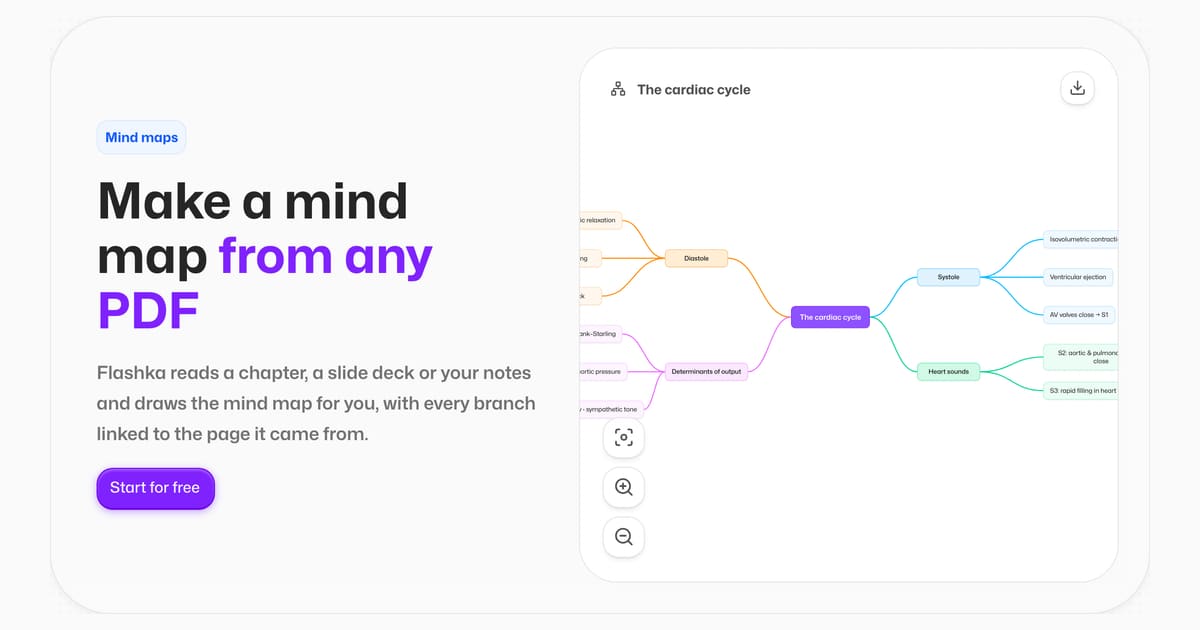
The hardest part of biochemistry is not one pathway but how they fit together. A map, with metabolism at the centre and each pathway as a branch, shows those links in a way a list of notes cannot. Drawing it yourself is valuable, but it is slow, and it is easy to leave out a pathway you have not reached yet.
Make the map yours: add nodes for the links your lecturer stressed, attach notes and formulas to a node, and focus on one branch at a time when you revise a single pathway. A deck can hold one map per lecture, and you can download each map as an image to print.
Then test yourself on it. Cover a branch and say what is on it, or redraw it from memory. For more on building maps that help you learn, see how to make a mind map for studying.
Keeping it all until the exam
Biochemistry is cumulative. A pathway you learned in week three comes back in week nine as part of something larger. A few minutes of flashcards each day, scheduled with spaced repetition, keeps the early pathways ready for when the later ones need them. To fit biochemistry around your other modules, plan backwards from the exam date as in how to study for university exams.
The short version
- Learn each pathway's purpose, location, timing and regulation before its steps.
- Draw pathways from memory, check them, and draw them again.
- Use flashcards for details that must be exact.
- Connect the pathways into one map and test yourself on it.


