
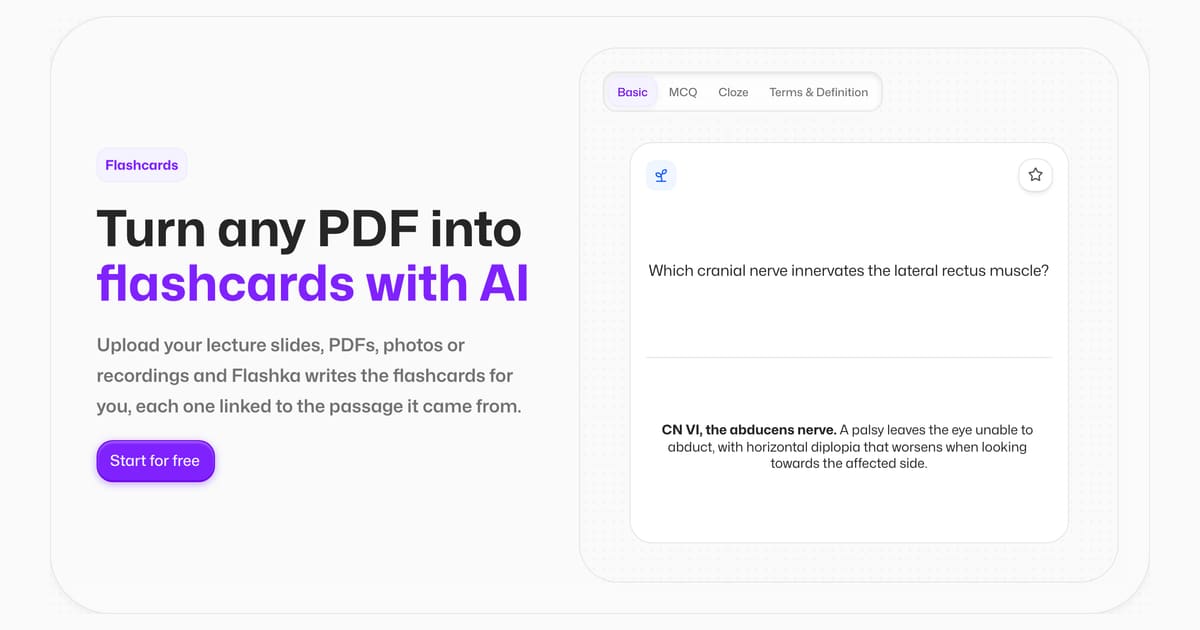
A cloze deletion flashcard is a sentence with one key word or phrase hidden, which you fill in from memory: 'The mitral valve sits between the left atrium and the left [...]'. Cloze cards are quick to make and well suited to definitions, exact wording, list items and vocabulary in context, but weaker for explaining how or why something works. Here is how cloze deletion flashcards work, when to use them, and how to write ones that teach you something.
What is a cloze deletion flashcard?
The name comes from the cloze test, a reading exercise in which words are removed from a passage and the reader fills them in. A cloze flashcard does the same with one sentence from your material:
- Front: Osmosis is the movement of water across a [...] membrane.
- Back: Osmosis is the movement of water across a partially permeable membrane.
You see the sentence with a gap, recall the missing part, then check. Because the sentence gives you context, a cloze card asks you to recall one piece of a fact rather than build the whole thing from nothing.
When to use cloze deletion flashcards
Cloze cards are a tool for specific jobs. Use them when the wording itself matters, and switch to a question when understanding matters more.
| Use a cloze card for | Use a question-and-answer card for |
|---|---|
| Definitions you must reproduce exactly | Explaining how a process works |
| Key terms inside a sentence | Why something happens |
| Items in a list, one per card | Comparing two things |
| Formulas, dates and numbers | Applying an idea to a new case |
| Foreign-language vocabulary in context | Questions your exam asks in its own words |
A useful test: if the exam will ask you to write the sentence, cloze it. If the exam will ask you a question about it, write the question.
How to write good cloze deletion flashcards
- Hide one thing per card. Several gaps in one sentence turn a card into a puzzle. If a sentence has three key terms, make three cards from it.
- Hide the important word, not filler. Gapping 'the' or 'is' tests grammar. Gap the term the exam cares about.
- Leave enough context for one answer. 'The [...] is important' could be anything. Keep the clue in the sentence that makes only one answer fit.
- Keep the sentence short. In a long sentence you can guess from the surrounding words without knowing the fact.
- Split lists. For a list of five, make five cards, each with one item hidden and the rest shown.
- Add a hint when two answers fit. A short hint such as '(organ)' or '(year)' says what kind of answer is wanted.
The weak spot of cloze cards
Cloze cards have one real weakness: it is easy to learn the sentence instead of the fact. After a few reviews you may fill the gap because you remember the shape of the sentence, then fail when the exam asks the same thing in different words.
Two habits protect against that:
- Mix card types. For every important cloze, add a question card that asks about the same idea another way.
- Test yourself outside the deck. Quizzes and practice questions phrase things differently. If you can answer there, you know it.
For the rules that apply to every card type, see how to make good flashcards.
Cloze cards in your study routine
Like any card, a cloze card only works if you see it again before you forget it. Review your cards with spaced repetition, a few minutes a day, and the definitions you need word for word will still be there on exam day.
Turning a whole PDF into cards? Our PDF to flashcards guide walks through it step by step.
The short version
- A cloze card hides one key word or phrase in a sentence for you to recall.
- Use it for definitions, exact wording, list items, formulas and vocabulary.
- Hide one important thing per card, and leave enough context for one answer.
- Pair cloze cards with question cards so you learn the fact, not the sentence.


