
To take notes in university lectures, skim the slides before you go, write down ideas and examples in your own words instead of copying sentences, mark anything you did not follow, and turn your notes into questions within a day. Good lecture notes are not a record of everything that was said. They are a short list of what mattered and what you still need to work out, ready to test yourself on.
Why most lecture notes do not help
In a university lecture the speaker moves faster than anyone can write. Most students respond by typing as much as they can, and end up with pages that look complete and teach them very little. While you are copying, you are not thinking about what the words mean.
The other common habit is the opposite: writing nothing because the slides will be online. Slides show the headings, but the explanation, the worked example and the hint about what will be examined are usually only spoken. Notes are where you catch those.
The aim is in between. Listen first, write second, and write only what you could not get from the slides.
Before the lecture: ten minutes that make notes easier
- Skim the slides if they are posted in advance. Read the headings and look at the diagrams, so nothing in the lecture is completely new.
- Open the slides beside your notes, on paper or on screen, so you can write on them instead of copying them.
- Write two or three questions you expect the lecture to answer. They give you something to listen for.
How to take notes in university lectures, step by step
- Write the topic and date at the top, so you can find the notes later.
- Listen for structure. Lecturers signal it: "there are three reasons", "the key point is", "this comes up every year". Write those signals down.
- Write ideas, not sentences. Short phrases, arrows and abbreviations you will still understand next week.
- Keep the examples. An example that was only spoken is often the most useful thing on the page.
- Mark what you did not follow with a question mark, and keep going. Stopping to work it out costs you the next five minutes.
- Leave space at the side or the bottom for questions you will write after the lecture.
Which note-taking method to use
There is no single right format. Pick one that fits the subject and use it every week, so your notes look the same when you revise.
| Method | How it works | Good for |
|---|---|---|
| Cornell | Notes on the right, questions in a column on the left, a summary at the bottom | Most subjects, and self-testing later |
| Outline | Headings and indented points | Lectures that follow a clear structure |
| Notes on the slides | Writing on a printed or digital copy of the slides | Slide-heavy lectures with diagrams |
| Mapping | A central topic with branches | Subjects where ideas connect in many directions |
| Recording and transcript | You listen in class and study from the transcript later | Fast lecturers, or studying in a second language |
If you want a structure that builds self-testing in, the Cornell method is a good place to start.
Laptop, tablet or paper?
Use whatever lets you think rather than transcribe. Typing is fast, which makes it tempting to copy word for word. Handwriting is slower, which forces you to choose what to write. A tablet with a pen lets you write directly on the slides. Whichever you pick, close everything else on the screen.
Record the lecture so you can stop copying
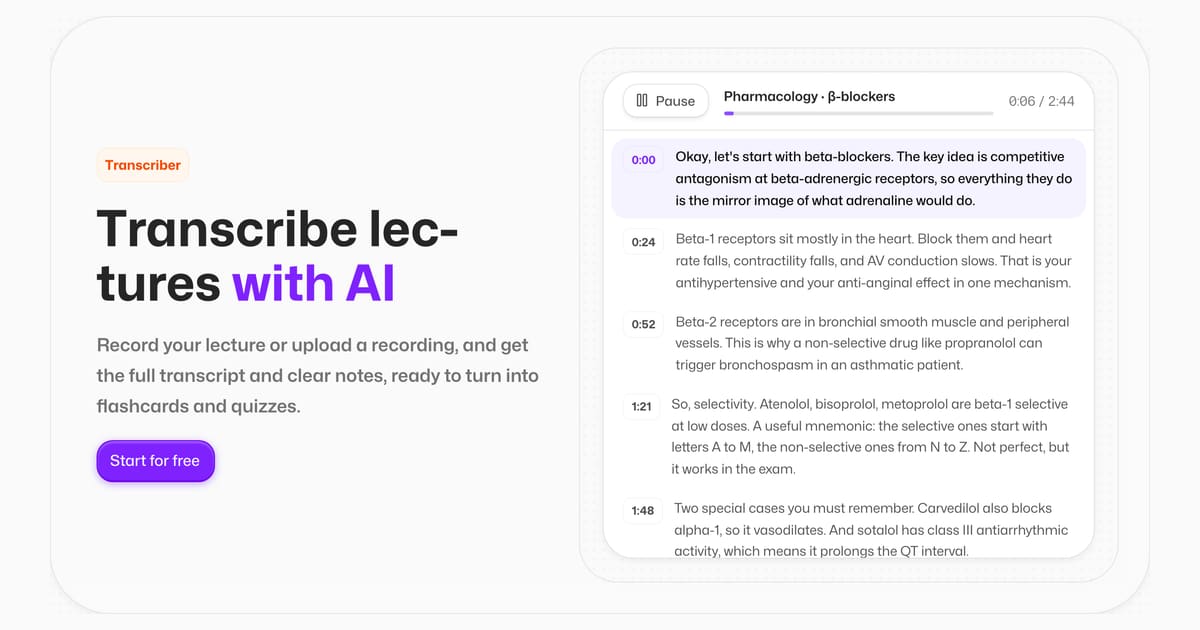
The pressure to write everything comes from the fear of missing something. If the lecture is recorded, that fear goes away, and you can spend the hour listening and noting only what you want to think about. Check your university's rules on recording first, and ask the lecturer if you are unsure.
The transcript is not live: it is ready shortly after you stop. As the recording plays back, the line being spoken is highlighted, and tapping a line jumps to that moment, so the parts you marked with a question mark are easy to find again.
After the lecture: turn notes into questions
Notes you only reread fade quickly. Within a day, go back through them and write a question for each main idea, then cover the notes and answer. This is active recall, and it is where most of the learning from a lecture happens.
Then put the questions somewhere you will see them again. A few minutes of flashcards a day, scheduled with spaced repetition, keeps a term's worth of lectures alive until the exam. If you have already fallen behind, read how to catch up when you are behind on lectures.
The short version
- Skim the slides first and arrive with a few questions.
- Write ideas, examples and signals of importance, not full sentences.
- Mark what you did not follow and keep listening.
- Within a day, turn your notes into questions and start reviewing them.


