
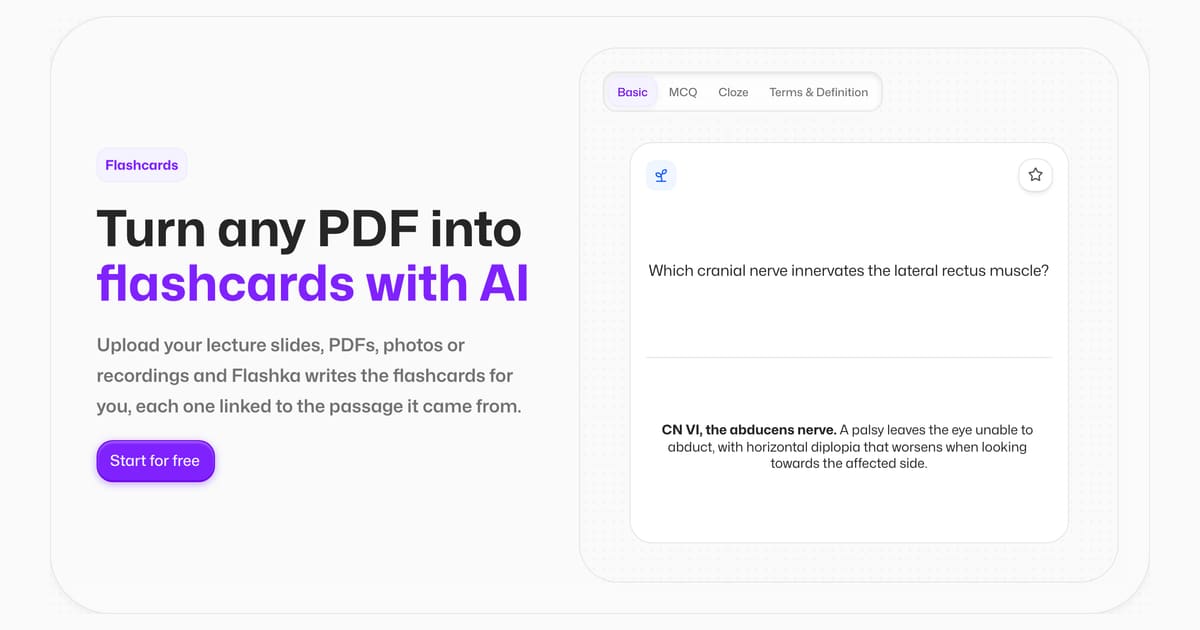
To make good flashcards, ask one thing per card, phrase the front as a question you must answer from memory, keep the back short, and write it in your own words from your own course material. Good cards are quick to review and hard to fake: you either recall the answer or you do not. These 12 rules show how to make good flashcards, with examples of cards that fail and how to fix them.
What makes a flashcard good?
A flashcard is a tool for active recall: it asks a question, and the effort of answering is what strengthens the memory. A good card makes that effort count. A bad card lets you recognise the answer without recalling it, or asks so much that you can never quite get it right.
Most bad flashcards fail in one of three ways: they are too big, too vague, or they test something the exam will never ask.
How to make good flashcards: 12 rules
Rules for the front
- Ask one thing. One fact, one concept, one step. If the answer contains an 'and', it is probably two cards.
- Make it a question. 'Mitochondria' is a topic. 'What does the mitochondrion produce?' is a card.
- Be specific enough to have one answer. 'What about the French Revolution?' has a hundred answers. 'In what year did the French Revolution begin?' has one.
- Do not give the answer away. If the wording hints at the answer, you will learn the hint, not the fact.
Rules for the back
- Keep it short. A word, a phrase or a sentence. With a paragraph on the back, you will only ever half-remember it.
- Write it in your own words. Rewording forces you to understand it, and you will recognise your own phrasing when the card comes back.
- Add the why, briefly. One short clause of context ties the fact to something you already know.
- Use pictures where words struggle. Anatomy, maps, circuits and diagrams are easier to learn as a labelled image with the labels hidden. See how image occlusion works.
Rules for the deck
- Make cards from what is examined. Your lectures, your syllabus, past papers. Not everything in the textbook.
- Split lists. A seven-item list on one card is impossible to grade honestly. Use one card per item, or one cloze per item.
- Delete what you already know. Every card you could answer last year costs you reviews for months.
- Rewrite cards you keep failing. A card you miss again and again is usually badly made, not too hard.
Good flashcards vs bad flashcards
| Bad card | Better card | Rule |
|---|---|---|
| Front: Photosynthesis | Front: Which gas do plants take in for photosynthesis? Back: Carbon dioxide | 2 |
| Front: Name the four chambers of the heart and what each does | Four cards, such as 'Which chamber pumps blood to the lungs?' Back: Right ventricle | 1, 10 |
| Front: Function, location and structure of the kidney? | Three cards: one each for function, location and structure | 1 |
| Back: a full paragraph copied from the slide | Back: one sentence in your own words | 5, 6 |
| Front: The ___ is the powerhouse of the cell | Front: Which organelle produces most of the cell's ATP? | 4 |
Which card type to use
Not every fact suits a question-and-answer card. Match the card to what you need to recall:
- Question and answer for concepts, mechanisms and explanations.
- Cloze deletion for definitions and wording you need exactly. Here is when to use cloze cards.
- Multiple choice if your exam is multiple choice.
- Term and definition for vocabulary and key terms.
- Image occlusion for labelled diagrams.
Should you write flashcards by hand or with AI?
Writing cards yourself makes you process the material, which helps. It also takes hours you could spend reviewing. A middle path works for many students: let AI write a first draft from your own material, then edit every card that does not sound like you and delete the ones you do not need.
We weigh up both approaches in handwritten vs AI flashcards. Whichever way you make them, the rules above still decide whether a card is worth reviewing.
The short version
- One question per card, specific enough to have one answer.
- A short back, in your own words, with a little context.
- Split lists and multi-part questions; use images for diagrams.
- Make cards from what is examined, delete what you know, and rewrite what you keep failing.


