
The Pomodoro technique for studying is a way to work in timed focus blocks with short breaks: traditionally 25 minutes of focused work, a 5-minute break, and a longer break of 15 to 30 minutes after four rounds. Each block has one task and a clear end, which makes it easier to start and to stay with. It works well when you decide in advance what each block is for and fill it with active work, such as flashcards or practice questions, rather than rereading.
Where it comes from
The technique was developed by Francesco Cirillo in the late 1980s, when he was a university student, and is named after the tomato-shaped kitchen timer he used (pomodoro is Italian for tomato). Each focus block is called a pomodoro.
The idea is simple: a short, fixed stretch of work is easier to begin than an open-ended one, and a scheduled break is easier to come back from than one you drifted into.
How to use the Pomodoro technique for studying
- Choose the task for the block. One task: "20 cards on chapter 3", or "questions 1 to 5 of the problem set".
- Set a timer for 25 minutes. Work only on that task. If something else comes to mind, write it down and carry on.
- Take a 5-minute break when it rings. Stand up, move, get some water, away from the screen if you can.
- Repeat. After four blocks, take a longer break of 15 to 30 minutes.
- Note what you finished. A tally of completed blocks is a simple record of the day, and tells you how many blocks a task really takes.
Adapt the lengths to the work
25 and 5 are the classic numbers, not rules. Change them to fit the task and your attention.
| Focus block | Break | Suits |
|---|---|---|
| 15 minutes | 3 to 5 minutes | Getting started on a hard day; short reviews |
| 25 minutes | 5 minutes | Flashcards, quizzes, reading with questions |
| 50 minutes | 10 minutes | Problem sets, essays, coding: work that needs warming up |
| 90 minutes | 15 to 20 minutes | Past papers under exam conditions |
If a timer cutting you off mid-problem annoys you, use longer blocks for deep work and short ones for review. If you cannot start, shorten the block until starting feels easy. Our guide on how to study with ADHD builds on the same idea of short, timed sessions.
What to do inside a pomodoro
A timer only measures time; what you do in the block decides whether it helps. Useful blocks ask you for answers:
- Review flashcards that are due.
- Take a short quiz on one chapter.
- Blurt: close your notes, write everything you remember, then check. See the blurting method.
- Solve problems without looking at the worked solution first.
Avoid filling blocks with rereading or copying notes out neatly. They feel productive but ask little of your memory, so 25 minutes pass with little to show for them.
Use a timer
Any timer works: a kitchen timer, your phone in focus mode, or an app. On the web, Flashka's dashboard has a Study Timer widget you can switch on under Customise. Set the length of your focus time, short break and long break, press Start, and pop it out as a floating timer while you study. You can let the next session start by itself.
Plan the rounds, not just the blocks
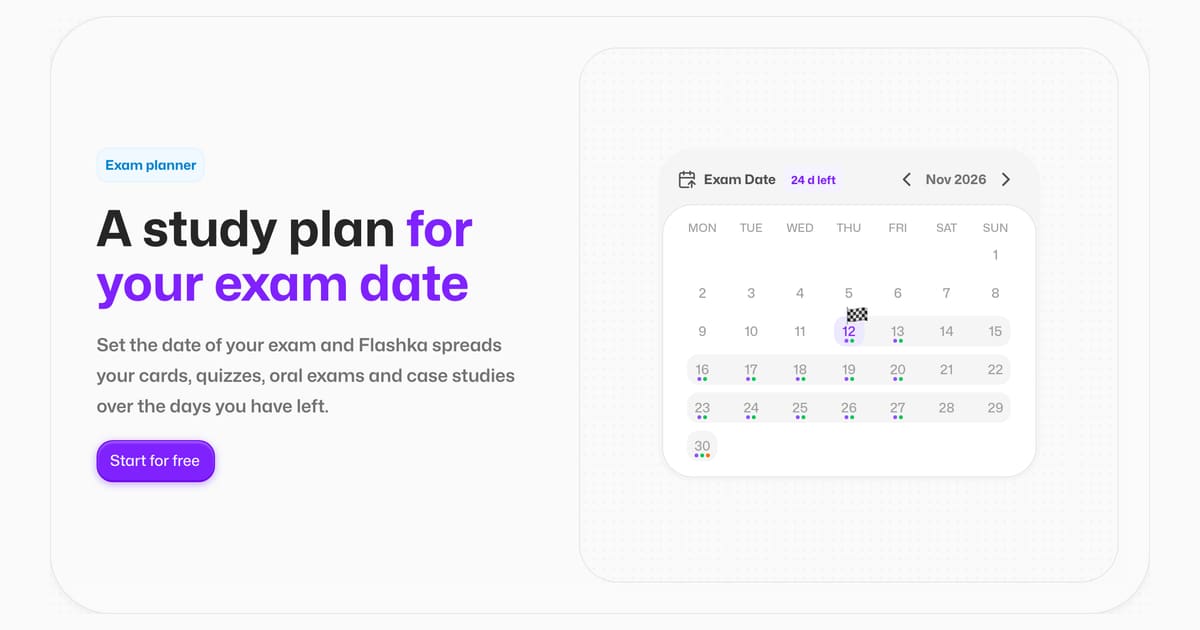
Pomodoro tells you how to work for the next 25 minutes. It does not tell you what to work on today, or whether today's blocks add up to being ready on exam day. For that you need a plan.
The plan sends a daily reminder to study, follows you between your phone, tablet and computer, and lets you raise or lower any day's targets when your week changes. Making a plan is free; the sessions it schedules use each tool's own allowance.
Common Pomodoro mistakes
- Skipping breaks. The break is what keeps the next block sharp.
- Breaks that grow. Time the break too, and do not start a video.
- Blocks without a task. "Study" is not a task; "15 cards" is.
- Counting blocks instead of results. Four pomodoros of rereading are not four of recall. For what to put in a whole day, see how long you should study a day.
The short version
- Work in timed blocks, traditionally 25 minutes, with 5-minute breaks and a longer break after four.
- Adapt the lengths to the task.
- Fill each block with one active task: cards, a quiz, problems.
- Let a plan decide what today's blocks are for.


