
How long should you study a day? For most school students, one to two focused hours outside class on a normal day is a realistic range, with more at university and in the weeks before exams. But the number of hours matters less than what you do in them: two hours of answering questions and reviewing on a schedule does more than five hours of rereading. Your own number comes from your exam dates, how much there is to cover and how much you can keep up every day.
Count focused hours, not hours at the desk
An hour at the desk with a phone beside you and a textbook open is often twenty minutes of studying. When you ask how long to study, count focused time: minutes spent recalling, solving and practising, not minutes in the chair.
Spreading study out also beats bunching it. The same hours split over many days are remembered better than one long session, because of the spacing effect: memories revisited after a gap last longer. A short daily session is worth more than a long weekly one, which we compare in cramming vs spaced repetition.
A rough guide by situation
| Situation | Focused study a day, roughly | Notes |
|---|---|---|
| School, normal term | 1 to 2 hours | Homework included; more in exam years |
| School, weeks before exams | 2 to 4 hours | Split across subjects, with breaks |
| University, during term | 2 to 4 hours outside lectures | Depends on your course and its workload |
| University, revision period | 4 to 6 hours | In blocks, with real breaks |
| Exam in less than a week | What you can sustain while still sleeping properly | Review and practice, not new material |
These are rough estimates, not rules. A heavy course, a weak subject or a late start pushes the number up; a subject you know well pulls it down. At UK universities, a credit is usually counted as about ten hours of learning, lectures included, which is one way to see how much your course expects of you.
How to work out your own number
- List what you need to cover. Lectures, chapters and past papers, for each exam.
- Count your real study days. Take out days you work, travel or rest. A plan that assumes seven full days a week breaks in the first week.
- Divide. What there is to cover, divided by the days you have, is your daily target. Keep the last days before each exam for review only.
- Check it against your time. If the daily target does not fit the hours you really have, start sooner, cut what is unlikely to be examined, or both.
- Run it for a week, then adjust. If you finish early, raise it. If you never finish, lower it before you fall behind.
For flashcards there is a simpler answer: review every card that is due, and choose only how many new cards to add. We work it out in how many flashcards to review a day.
What to do with the time
A study day that works usually has three parts:
- Review what is due, so what you learned last week stays.
- New material: one lecture or chapter, read with the question "what would the exam ask?".
- Practice: a quiz, past-paper questions, or explaining a topic out loud.
Work in blocks of 25 to 50 minutes with a short break between; the Pomodoro technique explains how. And stop at a planned time. Studying until midnight every night does not add up if it wrecks the next morning.
Let the exam date set the number
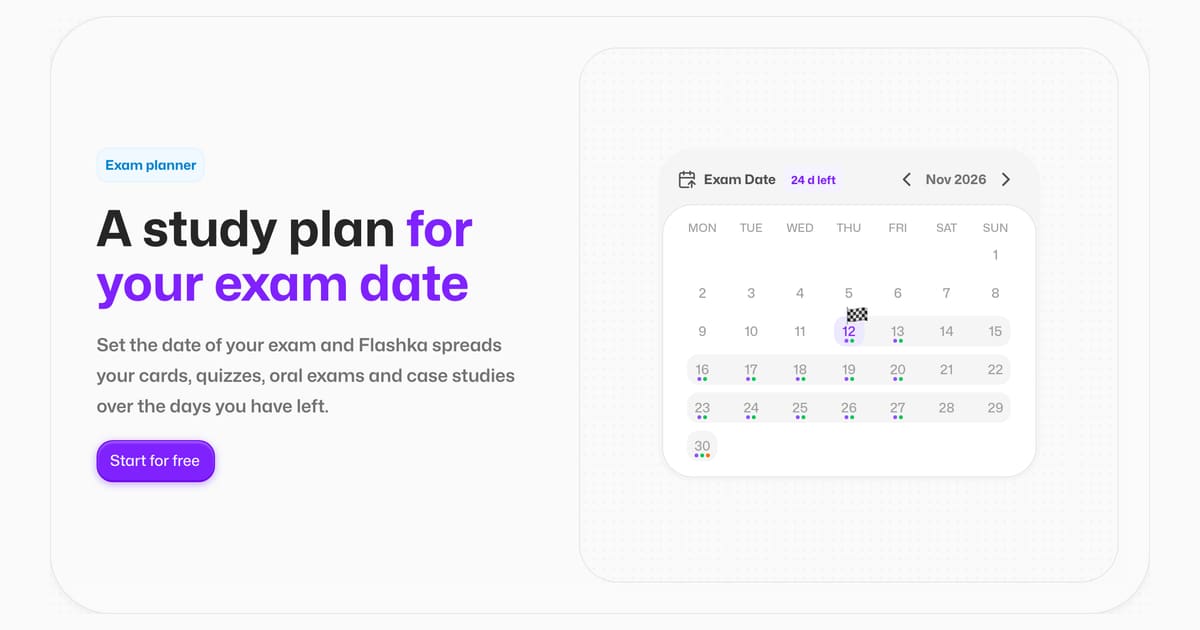
Working out a daily number by hand for every subject is tedious, and it changes every time your week does. An exam planner does the arithmetic for you.
When your week changes, raise or lower any day's targets and the plan shows what remains. With less than a week left, it switches to an intensive schedule. Each deck has its own plan and exam date, so you can make one per subject. Making a plan is free; the sessions it schedules use each tool's own allowance.
The short version
- One to two focused hours a day is a realistic range at school; more at university and before exams.
- Count focused time, not time at the desk, and spread it over many days.
- Work out your number from what you need to cover and the days you have.
- Review, learn something new and practise every day, then stop at a planned time.


