
To study smarter, not harder, change how you study before you add hours: test yourself instead of rereading, spread reviews over days, mix topics, study what the exam actually asks, and turn every mistake into something you will see again. The first two are well supported by learning research, and none of them costs extra time; most of them save it. Here are eight, with what each one replaces.
What studying harder usually looks like
Long hours of rereading, highlighting and copying notes out neatly. It feels like work, and it builds familiarity: the page looks known. But exams ask you to produce answers, not to recognise pages, and familiarity fades within days.
Studying smarter means spending the same hour on things that make you produce, space out and apply what you know.
8 habits for studying smarter
- Test yourself instead of rereading. Close the book and answer questions. Retrieving a fact strengthens it more than seeing it again. This is active recall.
- Space your reviews. Come back to a topic after a day, then a few days, then a week. Spaced reviews last longer than the same time spent in one block.
- Mix topics in practice. Alternate problem types instead of doing twenty of the same kind. It is harder, and it trains you to choose the method, as the exam will make you do.
- Study what is examined. Start from the syllabus, past papers and what the lecturer stressed, not from every page of the textbook.
- Make small, sharp flashcards. One question per card, short answer. A card you can rate honestly is a card that works. Here are the rules for good flashcards.
- Explain it in plain words. If you cannot explain a topic simply, out loud, you do not know it yet. Explaining shows the gaps that rereading hides.
- Turn mistakes into cards. Every question you get wrong in a quiz or past paper becomes a flashcard, so the gap comes back until it closes.
- Protect your focus. One task, phone away, timed blocks. An hour of real attention beats three distracted ones; see how to stay focused while studying.
Harder vs smarter
| Studying harder | Studying smarter | Why |
|---|---|---|
| Rereading a chapter three times | Answering questions on it, then again a few days later | Recall strengthens memory; recognition does not |
| One long session on Sunday | Twenty minutes most days | Spaced reviews last longer |
| Highlighting everything | Turning key points into questions | Highlighting asks nothing of your memory |
| Twenty problems of the same type | Mixed problems | You learn to pick the method |
| Starting from page one of the textbook | Starting from past papers and the syllabus | Your time goes to what is examined |
Spend your time answering, not preparing
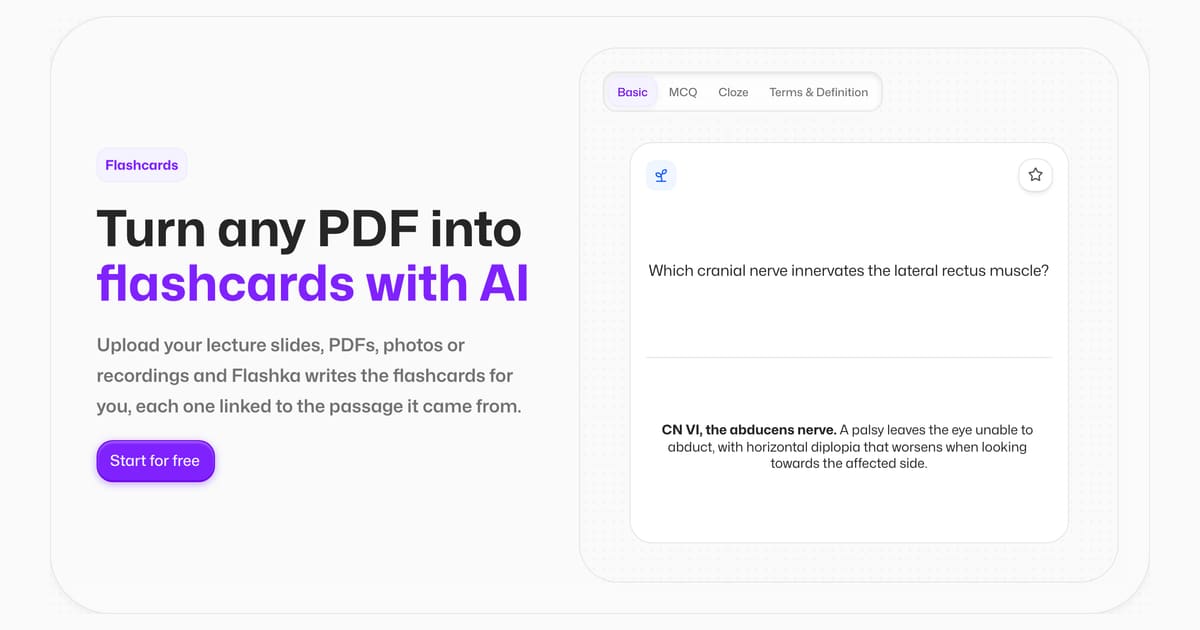
The expensive part of studying smart is the setup. Writing a hundred flashcards for one lecture can take an evening, and that evening is not spent reviewing. Many students give up on active recall right here: they agree it works, then never find the time to write the questions.
This is where AI helps without doing the learning for you. It writes the first draft of the questions from your own material, and you do the remembering.
Then the habits run themselves. Spaced repetition brings each card back just before you would forget it, using SM-2 on Anki's default learning steps. A card you keep forgetting is marked Critical, so you know which ones to rewrite. From the same material you can take a quiz that mixes question types, or ask Professor Ka, Flashka's AI tutor, to explain a card you do not get. He answers from your own documents and names the page he used.
Where to start
You do not need all eight habits this week. Start with two that change a lot for little effort: swap one rereading session for a set of questions, and come back to the same questions in three days. When those feel normal, add the rest one at a time.
The short version
- Test yourself instead of rereading, and space your reviews.
- Mix problem types and start from what is examined.
- Keep flashcards small, explain topics in plain words, and turn mistakes into cards.
- Protect your focus, and let tools take the setup work so your time goes to recall.


