
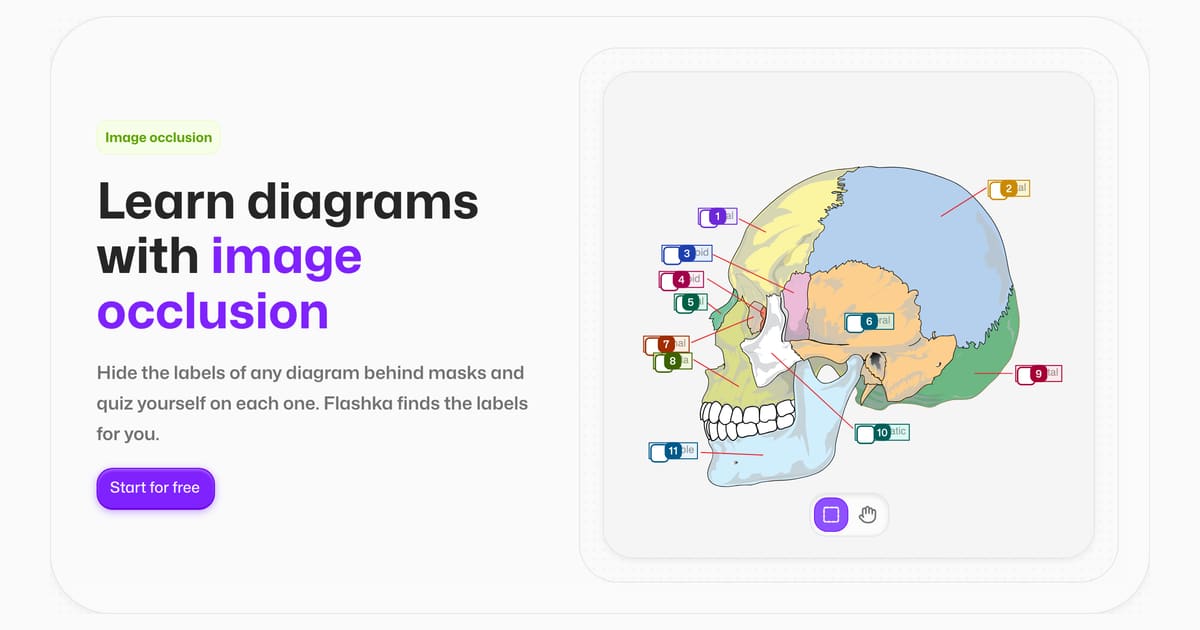
To study physiology, learn each body system in two layers: the structures on its diagrams and the mechanisms that connect them, written as cause-and-effect chains you can explain out loud. Test yourself on the diagrams with the labels hidden, practise each mechanism step by step without notes, and review both on a spaced schedule. Physiology is less about lists than about being able to say what happens next, and why.
How physiology differs from anatomy
Anatomy asks where things are. Physiology asks how they work: how a system responds when something changes, how one organ affects another, what a graph or a trace shows. You still need the structures, but most of the marks are in the mechanisms.
That means two kinds of revision. Diagrams and terms are a memory task, done well with flashcards and image occlusion. Mechanisms are an explanation task, done well by explaining out loud and putting steps in order. If you are studying anatomy alongside, our guide on how to study anatomy covers the structural side.
How to study physiology, step by step
- Go system by system. Finish one before starting the next, in the order your course teaches them.
- Learn the diagrams first. Name every labelled structure on the figures your lecturer uses, with the labels hidden.
- Write each mechanism as a chain. The change, what detects it, what responds, what happens, how the system returns to normal. One step per line.
- Explain the chain out loud, without notes. Where you hesitate is what to study next.
- Ask "what if?" What happens if one step fails, or one value rises? Exam questions often start here.
- Read graphs and traces actively. For every curve your course uses, say what is on each axis and what each part of the curve means.
- Review a little every day. Systems learned early still have to be there at the exam.
One way to learn each mechanism
| Step | Question to ask yourself |
|---|---|
| The change | What has changed, and from what normal state? |
| Detection | What senses the change, and where? |
| Response | What signal is sent, and to what? |
| Effect | What does the effector do? |
| Return | How does the system get back to normal, and what ends the response? |
| Failure | What happens if this step does not work? |
Not every mechanism fits this shape exactly, but many regulatory loops do, and asking the same questions every time shows you where your understanding has a gap. Check every chain against your lecture notes; your course decides the level of detail.
Test the diagrams with the labels hidden
Physiology figures, such as the parts of the nephron or the conduction system of the heart, are often tested as images: a figure with an arrow and a question. Labelling from memory is the skill to practise.
Hide One covers only the label being asked and leaves the rest visible, which is easier in the first days of a new system. Hide All covers every label, so you recall each one without hints from its neighbours. Drawings without text labels need their masks added by hand. Occlusion cards are studied with spaced repetition like the rest of your deck, and medical students can switch to the Med Student preset, made for a heavy workload.
Practise the mechanisms
Cards suit terms and structures, but a mechanism is a sequence. Flashka gives you two ways to practise it from the same lecture. A quiz includes question types such as putting the steps in order, and open answers graded by AI. An oral exam with Professor Ka asks you to explain a topic out loud and follows up on the gaps, as an examiner would.
Explaining in plain words is the test of understanding; the Feynman technique is a simple routine for it.
Common physiology mistakes
- Memorising chains word for word. If you cannot explain a step in your own words, you do not understand it yet.
- Learning diagrams without mechanisms, or mechanisms without the diagram. Exams join them.
- Skipping the graphs. Curves and traces are a favourite exam format.
- Leaving whole systems to the end. Steady daily review keeps up with the volume; see how long you should study a day.
The short version
- Learn each system as diagrams plus mechanisms.
- Write mechanisms as cause-and-effect chains and explain them out loud.
- Test the diagrams with image occlusion, moving from Hide One to Hide All.
- Practise sequences with quizzes and oral exams, and review daily with spaced repetition.


