
To study pharmacology without drowning in drug names, learn drug classes before individual drugs. For each class, know the mechanism, the main uses, the key side effects and the important contraindications, then hang individual drugs on that frame. Name stems such as -olol and -pril tell you the class of many drugs at a glance. Turn each fact into a short flashcard, review on a spaced schedule, and practise applying it on patient cases.
Why pharmacology feels like drowning
A pharmacology course can introduce hundreds of drug names, each with uses, side effects and interactions. Learning them one by one, as a list, is how students drown. Most of what you need about a drug follows from its class, so the class is the unit to learn.
The other trap is learning facts without the reason behind them. A side effect you can explain from the mechanism is one you can work out again in the exam, even when memory wobbles.
Learn classes first, drugs second
For each class, learn the same five things, in the same order:
- Mechanism: what it does at the receptor, enzyme or channel.
- Uses: the conditions it treats, in your course's words.
- Side effects: the common ones and the dangerous ones, and how they follow from the mechanism.
- Contraindications and interactions: when it should not be given.
- Prototype: one drug that stands for the class, and what makes the others different.
Once a class is solid, a new drug name needs only one or two cards: which class it belongs to, and anything it does differently from the prototype.
Use drug name stems
Many drug names carry their class in their ending. Learn the stems as cards of their own and a long list of names starts sorting itself.
| Stem | Class | Examples |
|---|---|---|
| -olol | Beta blockers | Propranolol, atenolol |
| -pril | ACE inhibitors | Lisinopril, ramipril |
| -sartan | Angiotensin II receptor blockers | Losartan, valsartan |
| -statin | Statins (HMG-CoA reductase inhibitors) | Atorvastatin, simvastatin |
| -prazole | Proton pump inhibitors | Omeprazole, lansoprazole |
| -mab | Monoclonal antibodies | Rituximab, infliximab |
Stems have exceptions, so treat them as a first guess and learn the list your course gives you.
How to study pharmacology with flashcards
Pharmacology suits flashcards because it is a large set of small, exact facts that you need to recall quickly. Three rules make the cards work:
- One fact per card. "Common side effects of ACE inhibitors?" beats "Everything about ACE inhibitors".
- Ask why, not only what. "Why can ACE inhibitors cause a dry cough?" ties the side effect to the mechanism, which makes both easier to keep.
- Match the card to the exam. Cloze cards for lists you need word for word, multiple choice if your exam is multiple choice.
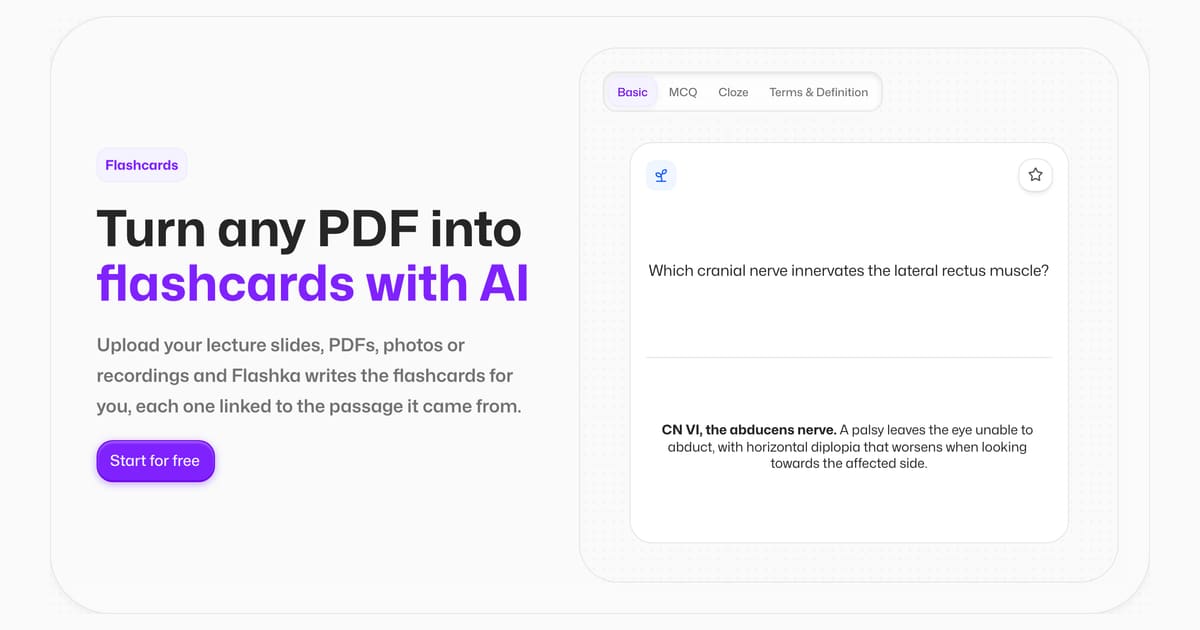
Writing hundreds of these by hand is where the evenings go. Generating them from your lecture slides takes that part away, and leaves you the part that matters: checking and studying them.
Then review with spaced repetition. Flashka schedules every card with SM-2 on Anki's default learning steps, and the Med Student preset suits a heavy workload. A card you keep forgetting is marked Critical, so you know which ones to rewrite or split.
Practise on patient cases
Exams rarely ask about a drug in isolation. They describe a patient with several conditions and ask what to start, stop or watch for. That is a different skill from recalling a list, and it needs its own practice.
Once a class is learned, test it on cases. Flashka's case studies are written from your own notes and graded against a model answer, showing what you got right and what you missed. The method behind it is in our guide to the case method.
A weekly pharmacology routine
| When | What |
|---|---|
| Every day | Clear your due flashcard reviews |
| After each lecture | Generate cards from the slides and delete the ones you already know |
| Every week | One or two cases on the classes you covered |
| Before the exam | A quiz on the whole module to find the gaps |
The short version
- Learn classes first: mechanism, uses, side effects, contraindications and a prototype.
- Use name stems to sort new drugs into their classes.
- Keep one fact per card, generated from your slides and reviewed daily with spaced repetition.
- Practise applying it on patient cases before the exam.


