
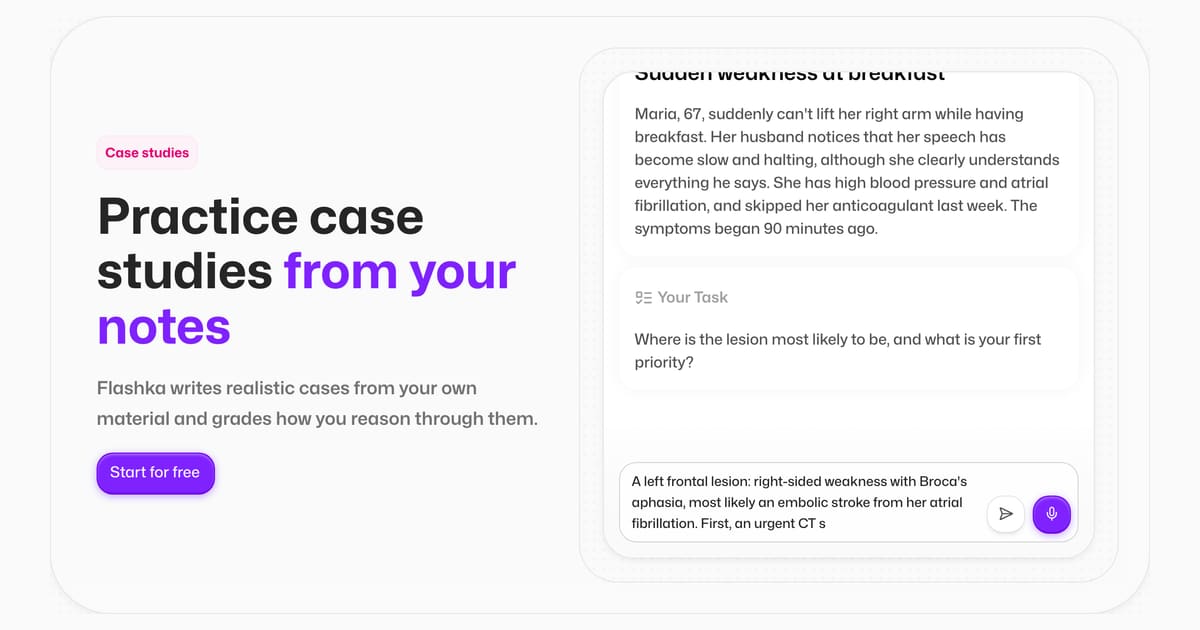
The case method is a way of learning in which you work through real or realistic situations and decide what should be done, instead of memorising rules on their own. To study cases in law, business and medicine, read each case with the question in mind, break the facts down with your subject's framework, write your answer before you look at anyone else's, and compare it with a model answer. Case exams test knowledge you can apply, and the only way to build that is to practise applying it.
What is the case method?
A case is a story with a problem in it: a patient with symptoms, a company with a decision to make, two parties in a dispute. The case method asks you to act as the professional would, using what you know to reach a judgement and defend it.
It is how many law and business schools teach, and how clinical years are examined. It works because it is a demanding form of active recall: you have to pull the right rule or mechanism out of memory and use it on facts you have not seen before. That is harder than recognising it on a page, and it lasts longer.
How to study cases in 5 steps
- Read the question first. Know what you are being asked to decide before you read the facts, so you read with a purpose.
- Read the case twice. Once for the story, once to mark every fact that could change the answer.
- Apply a framework. Use the structure your subject expects (see the table below) so you do not skip a step under pressure.
- Write your answer before you check anything. A plan in your head always feels complete; a written answer shows the gaps.
- Compare it with a model answer. Note what you got, what you missed, and why you missed it. That list is what you study next.
One framework per subject
Each field has its own way of moving from facts to a decision. Learn the one your exams reward and use it every time, until it is automatic.
| Law | Business | Medicine | |
|---|---|---|---|
| The case gives you | Parties, facts and a jurisdiction | A company, its numbers and a decision to make | A patient's age, history and symptoms |
| A common framework | IRAC: issue, rule, application, conclusion | Situation, problem, options, recommendation | History, examination, differential diagnosis, investigations, plan |
| What examiners look for | The right rule applied to these facts | A decision backed by evidence from the case | Safe reasoning from symptoms to a plan |
| A typical mistake | Stating the law without applying it | Summarising the case instead of deciding | Naming a diagnosis without ruling others out |
Law
Spot every issue before you solve any of them. Many marks are lost on issues never raised, not on issues argued badly. For each issue, state the rule in a sentence, then spend most of your words applying it to the facts, including the facts that point the other way.
Business
A business case wants a decision. Describe the situation briefly, name the real problem (often not the one the protagonist complains about), weigh two or three options against the numbers in the case, and recommend one. Then say what you would watch to know whether it worked.
Medicine
Work from the patient to the plan. List the problems, build a differential diagnosis, choose the investigations that would tell the options apart, and only then commit. Say why you ruled out the alternatives: in a clinical case the reasoning is marked, not only the final answer.
The hard part: finding enough cases
The weak point of the case method is supply. A textbook has a few cases per chapter, past papers run out, and a case you have already seen tests your memory of that case, not your reasoning.
Generating cases from your own notes solves this. Every case is new, and every one is built on what your course actually taught, not on a syllabus from somewhere else.
When you submit, your answer is compared with a model answer and scored out of 100, with the points you hit and the points you missed marked. The model answer is shown with the feedback, and recent cases are not repeated, so you can practise the same topic again without meeting the same story.
Make cases part of your week
- Learn first, then apply. Keep the facts underneath alive with spaced repetition during the week, and use cases to put them to work.
- One case a day beats ten the night before. Short, regular practice builds the habit of reasoning in a structure.
- Keep a list of what you missed. Every point from your feedback becomes a flashcard or a topic to reread.
- Say it out loud. If your exam includes a viva or a spoken station, practise explaining your reasoning in an oral exam as well.
The short version
- The case method teaches you to apply knowledge: read with the question in mind, use your subject's framework, write the answer, then compare it with a model answer.
- Law wants issues applied to facts, business wants a decision, medicine wants safe reasoning from symptoms to a plan.
- Fresh cases built from your own notes solve the supply problem.
- Pair daily case practice with spaced repetition for the facts underneath.


