
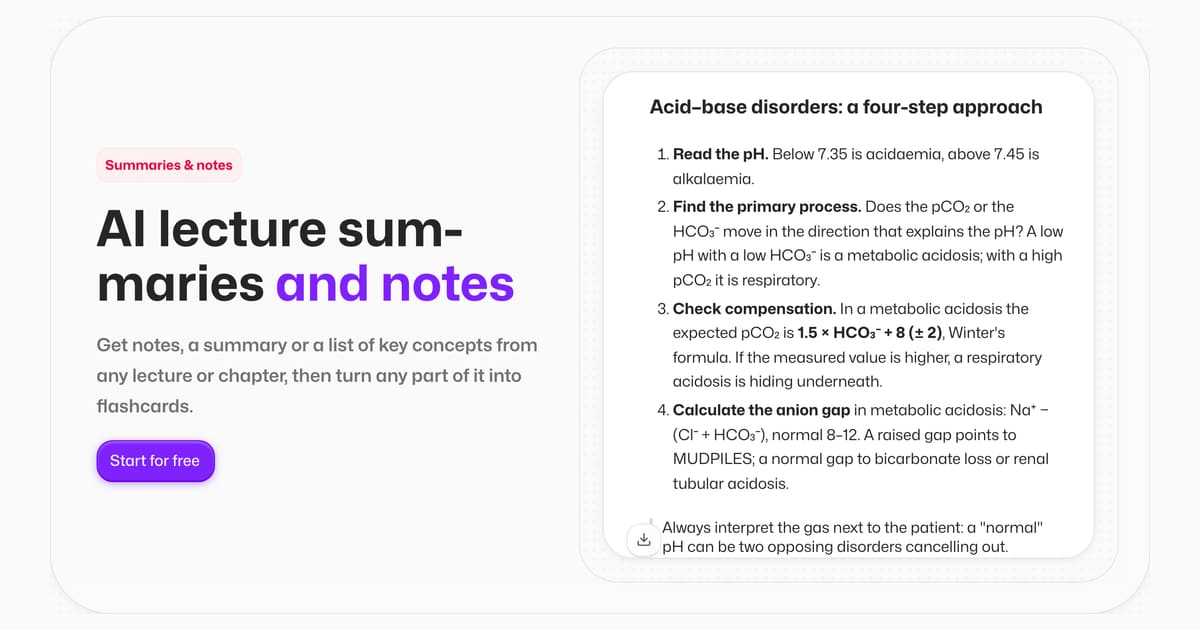
To make revision notes that actually help, start from the list of topics you will be examined on, write short notes in your own words after you have understood each topic, condense them in stages until a topic fits on one page, and add questions beside each point so you can test yourself. Revision notes are a tool for recall, not a copy of the textbook. Here is how to make revision notes you will use.
Why most revision notes do not help
Many students spend hours making beautiful notes and then wonder why the exam went badly. The problem is not the notes; it is what happens during the making. Copying from the textbook in neat handwriting feels like work, but it asks very little of your memory.
Notes help when making them makes you think: choosing what matters, putting it in your own words, and connecting it to what you already know. They help again when you use them to test yourself, not to reread.
How to make revision notes, step by step
- Start from the topic list. Use your specification or your teacher's list, so you make notes on what is examined and nothing else.
- Understand first, write second. Read the topic, close the book, then write. If you cannot write it without looking, read again.
- Use your own words. Short phrases, not full sentences copied out.
- Keep one topic per page, with a clear heading, so you can find and test each one.
- Add questions in the margin. For each point, write the question it answers.
- Condense in stages. Turn a page of notes into half a page, then into a few keywords on a card.
- Test yourself from the questions, covering the answers.
The condensing step is where the learning happens. Each time you shorten a topic, you have to decide what matters and how it fits together.
Which kind of revision notes to make
Different formats suit different material. Pick the one that matches what you need to recall.
| Format | Good for | Watch out for |
|---|---|---|
| Linear notes with headings | Most topics, a first pass | Turning into a copy of the textbook |
| Cornell notes | Notes with built-in questions and a summary | Skipping the question column |
| Mind maps | How ideas connect, causes and themes | Too many words on each branch |
| One-page summaries | A whole topic at a glance before the exam | Making them before you understand the topic |
| Flashcards | Facts, terms, definitions, formulas | Cards that ask more than one thing |
The Cornell method builds the questions into the page: notes on the right, questions on the left, and a summary at the bottom. It works for revision notes as well as lessons.
Turn your notes into questions
The most useful thing you can do with revision notes is stop reading them. Cover the page and answer the questions in the margin, or write everything you can remember about the topic on a blank sheet and then check, which is the blurting method.
Where a point is a fact you must recall exactly, such as a definition, a date or an equation, put it on a flashcard. Flashcards bring each fact back on a schedule, so you do not have to remember to revise it.
Common mistakes with revision notes
- Writing too much. If the notes are as long as the chapter, you have copied it.
- Spending longer on looks than content. Colour and layout help a little; hours of lettering do not.
- Making notes on everything. Leave out what you already know well.
- Never using them. Notes that sit in a folder until the night before have done half their job.
When to make revision notes
Make notes during the term, not only in the weeks before the exams. A topic noted soon after you learn it takes far less effort than one you have to relearn first. Then use the final weeks for condensing and testing, not for first drafts.
For a whole plan built around notes, flashcards and past papers, see how to revise for GCSEs.
The short version
- Make notes from the topic list, in your own words, after you understand each topic.
- Keep one topic per page and condense it in stages.
- Write a question beside each point and test yourself by covering the answers.
- Put facts you must recall exactly on flashcards, and leave out what you already know.


