
To remember what you read in a textbook, read one section at a time with a question in mind, close the book and recall what it said, write it down in your own words, and turn the key points into questions you review over the following weeks. Rereading feels like learning, but it mostly builds familiarity. Remembering comes from making yourself retrieve what you read, more than once, with gaps in between.
Why you forget what you read
Most of a chapter fades within days if you read it once and never use it again. That is normal: memory keeps what you use and lets the rest go.
The bigger problem is that reading feels like studying. On the second read every sentence looks familiar, so you feel you know it. But recognising a page is not the same as being able to recall it, and an exam asks for recall.
| Passive reading | Active reading |
|---|---|
| Read the chapter start to finish | Read one section, then stop |
| Highlight as you go | Highlight once you can say what mattered |
| Reread before the exam | Test yourself before the exam |
| Feels productive | Feels harder, works better |
Before you read: give yourself a map
Spend two or three minutes skimming the chapter: the headings, the figures, the summary at the end and any questions at the back. Then write down two or three questions you expect the chapter to answer.
This gives each new fact somewhere to go. It is the first step of the SQ3R method, which turns this whole approach into a routine.
How to remember what you read, section by section
- Read one section, a few pages at most.
- Close the book and say or write what it was about, without looking.
- Open the book and check what you missed or got wrong.
- Write a short note in your own words: the main idea and one example.
- Turn the key points into questions, with the answer on the other side.
- Move on to the next section.
Step 2 is the one people skip, and the one that matters most. Pulling an idea out of memory is what strengthens it; this is active recall. If you cannot say anything after a section, that is useful too: it tells you to read it again before moving on.
After you read: review with gaps
A chapter you recalled once is a good start, not the finish. Review your questions the next day, then a few days later, then a week after that. Each time you remember, the gap can grow. This is spaced repetition, and it is the difference between knowing a chapter for a week and knowing it on exam day.
Keep each session short. Ten minutes of answering questions does more than an hour of rereading the same pages.
Let Flashka do the writing, so you can do the remembering
Steps 4 and 5 are where most of the time goes. Flashka can do them from the chapter itself.
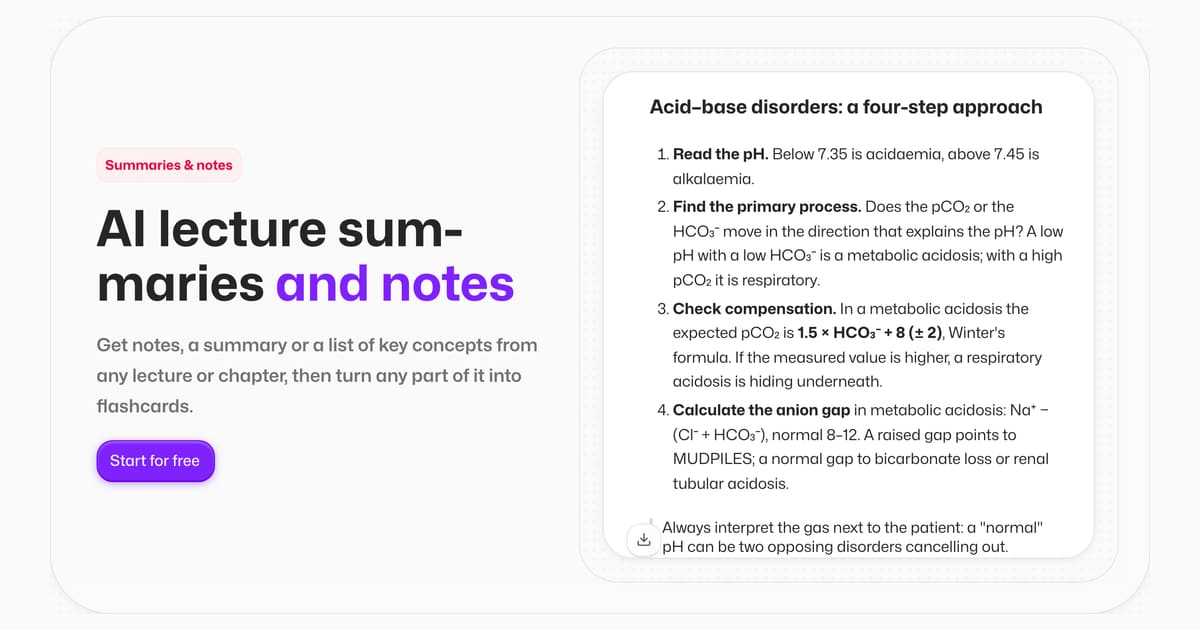
Add the chapter as a PDF to a deck. In an empty note, choose Generate Notes, Create Summary or List of Concepts, and the notes are written from your material. They are ordinary notes: edit them and add your own. The AI only ever fills an empty note, so what you wrote yourself stays as you wrote it.
Then highlight any paragraph, in the notes or in the PDF, and turn just that into flashcards. Review them with spaced repetition, which brings each card back just before you would forget it. If a passage makes no sense, ask Professor Ka, Flashka's AI tutor, who answers from your own documents and names the page he used.
Use the notes after you have tried to recall a section yourself, not instead of it. Checking your recall against good notes is active reading; reading the notes alone is rereading in a shorter form. For the whole route from a PDF to a deck, see how to turn a PDF into flashcards.
The short version
- Read one section at a time, with a question in mind.
- Close the book and recall it before you take notes.
- Turn key points into questions and review them over weeks, not hours.
- Let software write the notes and cards; spend your own time recalling.


