
To revise for a language exam, work from the exam's topics and format: build the vocabulary for each topic, practise speaking about those topics out loud until you can keep going for a minute or two, drill the grammar you keep getting wrong inside real sentences, and write timed answers in the format of the paper. Vocabulary is the foundation, but language exams test whether you can use it, out loud and on paper, under time.
What a language exam tests
Most school and university language exams test some mix of four skills: listening, reading, writing and speaking. The speaking part is often a conversation on set topics, sometimes with a picture or a role play; the written part asks for texts of a given length on given themes. Check your exam's format first, because the topics, the tasks and how they are marked shape everything else.
How to revise for a language exam, step by step
- Get the topic list. Family, school, the environment, technology: whatever your course sets. Each topic becomes a deck, or a section of one.
- Build vocabulary per topic. The words and phrases you would need to talk about it, each with an example sentence. Our guide to learning vocabulary with flashcards covers how.
- Learn useful structures, not just words. Opinion phrases, linking words and a few tenses you can show off. These lift every answer.
- Speak about each topic out loud. Answer likely questions without notes, for a minute or two. Where you stall is what to learn next.
- Drill your grammar mistakes in context. Every error you make in writing or speaking becomes a cloze card: the correct sentence with the tricky form blanked out.
- Write timed answers. In the length and format of the exam. Then check them, or ask a teacher to.
- Listen and read a little every day. Material on your topics, at your level.
Revising each part of the exam
| Part | What it asks | How to practise |
|---|---|---|
| Vocabulary | Words and phrases on set topics | Flashcards in both directions, reviewed daily |
| Grammar | Accurate forms in real sentences | Cloze cards made from your own mistakes |
| Speaking | Talking on a topic, answering follow-ups | Answering out loud without notes, with someone asking back |
| Writing | A text of set length on a theme | Timed answers, then corrections |
| Listening and reading | Understanding real language | Short daily input on exam topics |
Speaking: practise with someone who asks back
The speaking exam is where revising from a book helps least. You need to produce sentences on the spot, and the examiner's next question depends on your last answer. Rehearsing a memorised paragraph is a start; answering follow-up questions you did not expect is the real practice.
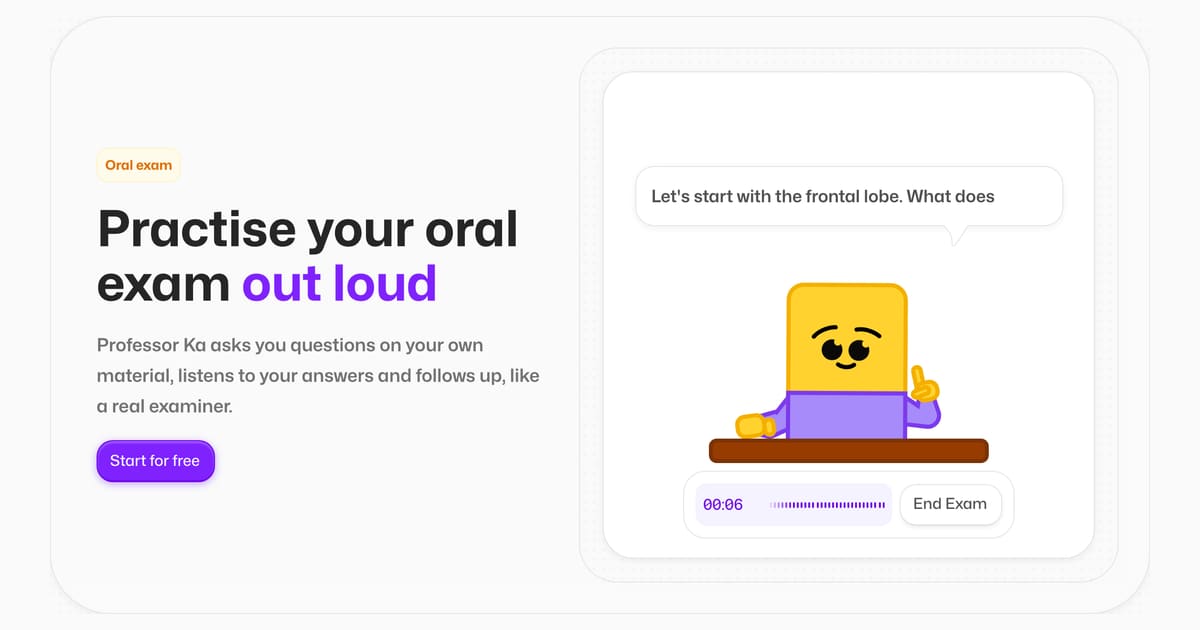
A teacher, a fluent speaker or a classmate is ideal, and a study group can take turns playing the examiner. When nobody is free, an AI examiner can ask the questions.
An oral exam lasts four to six answers and at most twelve minutes. For a "tell me about…" task, Open Recall gives you one broad question and up to thirty minutes to say everything you can, with Ka listening. The report checks what you said against your material; for pronunciation and fine points of grammar, a teacher's ear still matters.
Vocabulary and grammar: a few minutes a day
Take topic vocabulary from the material you actually use: your textbook chapter, your class handouts. Flashka can write term-and-definition cards with the front in one language and the back in another, from a PDF or photos of a textbook page, and spaced repetition brings each card back just before you would forget it.
For grammar, write your own cloze cards from your corrected work. A mistake you made once is a mistake you are likely to make again; a card makes it come back until it stops.
The last two weeks
- Speak every day on a different topic, out loud.
- Write two or three timed answers a week and check them.
- Keep reviewing cards, but stop adding many new ones.
- Rehearse the opening of each topic. A confident first sentence buys you time. If your mind goes blank on the day, see what to do when you blank in an oral exam.
The short version
- Work from your exam's topics and format.
- Build topic vocabulary and useful structures, and review them daily.
- Speak about each topic out loud and practise answering follow-ups.
- Turn your mistakes into cloze cards and write timed answers.


